Horror has always fed on what makes us vulnerable. Now one filmmaker is asking why the genre took so long to let queer characters own that vulnerability honestly.
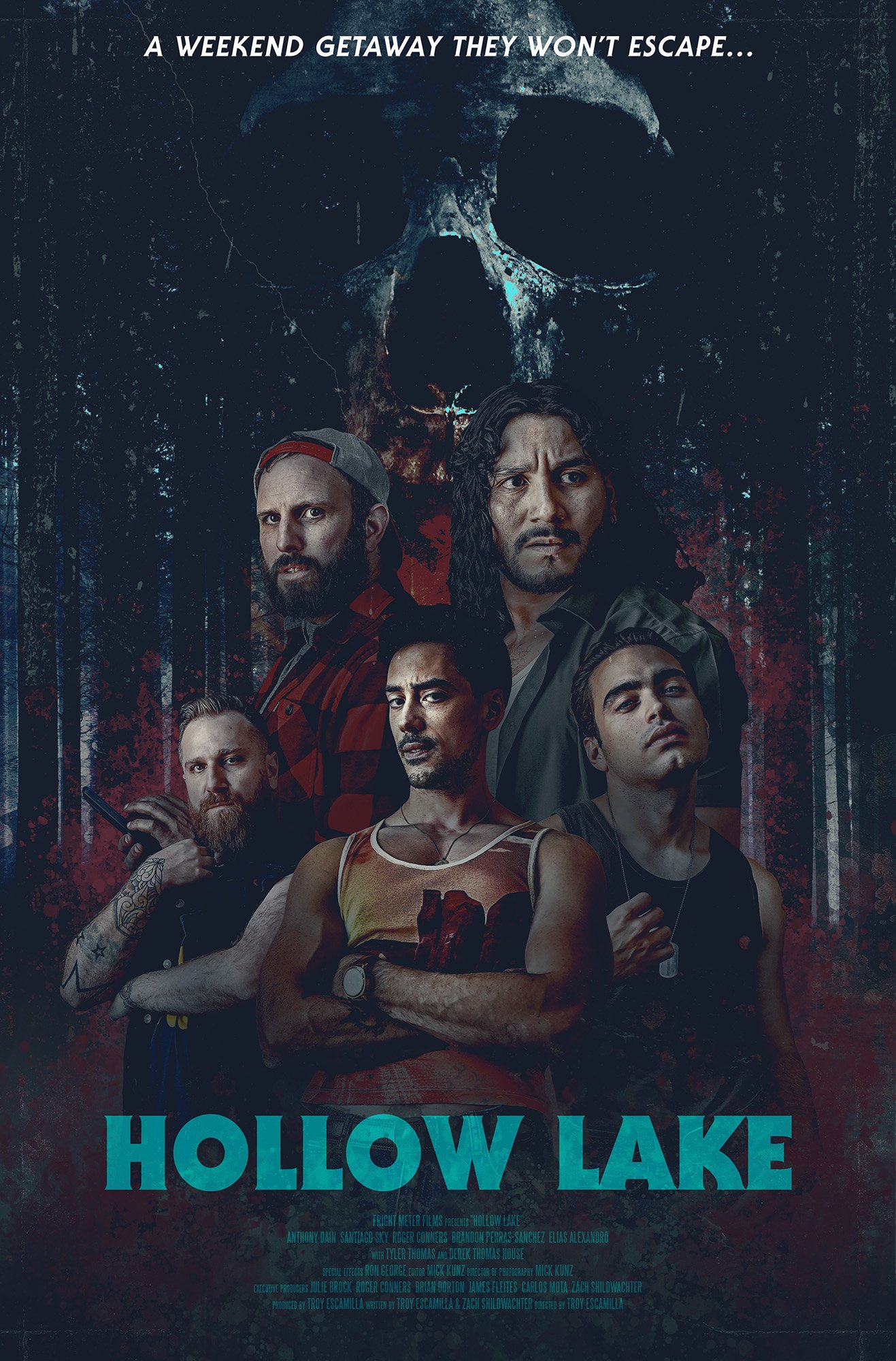
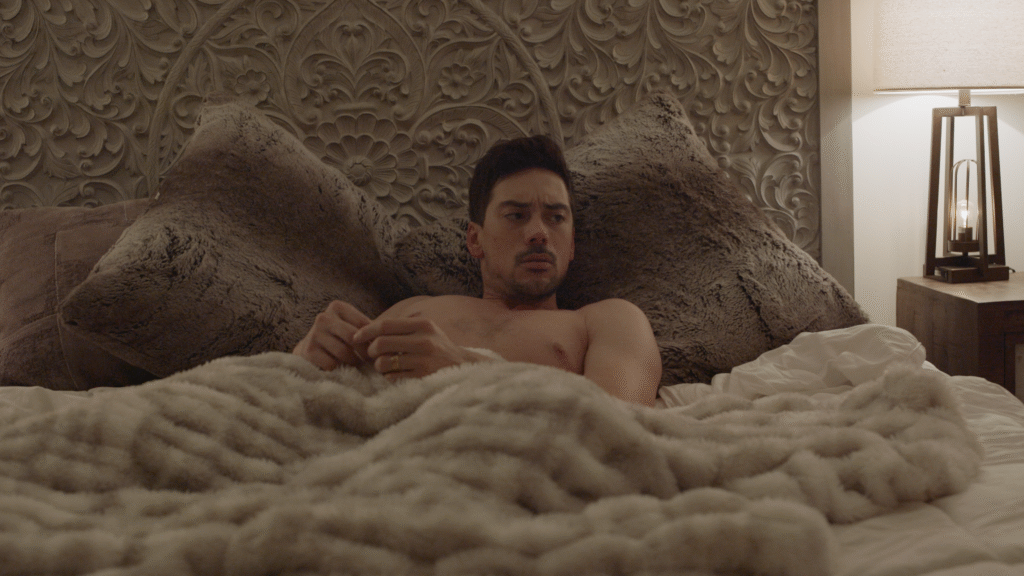
Hollow Lake, which had its Canadian premiere at the Toronto Indie Horror Fest earlier this year, follows a gay couple—Max (Anthony Dain) and Baker (Santiago Sky)—whose strained relationship is tested further when a stranger invades the remote home they’re staying in for a weekend.
The cast also includes Roger Conners, Brandon Perras-Sanchez, Tyler Thomas, Elias Alexandro and Derek Thomas House.
It’s a queer slasher built on queer intimacy rather than around it, written and directed by a gay filmmaker who grew tired of watching the genre borrow from queer anxiety without ever saying so out loud. The film’s next screening is May 15 at the Crimson Screen Horror Film Festival in Columbia, S.C.
“I wanted to see a relationship that felt real and lived-in,” said Troy Escamalia, the film’s director. “I think there’s still a hesitation in mainstream films to show queer relationships as anything other than polished or ‘acceptable.’ But real relationships are messy, complicated, and sometimes uncomfortable.”
That discomfort is the point. But to understand what Hollow Lake is doing, and why it matters, it helps to understand the genre it’s stepping into, and the long, tangled history between horror and queerness.
The slasher: a brief history of blood
The slasher genre as we know it traces its origins to 1960, when Alfred Hitchcock’s Psycho and Michael Powell’s Peeping Tom arrived within months of each other. Both films traded gothic monsters for human ones, turning the camera on voyeurism, repression and violence rooted in psychological damage rather than the supernatural. The infamous shower scene in Psycho, for example, shocked audiences. It redefined what horror could do with suspense, intimacy and the body.
It took more than a decade for the formula to crystallize. Bob Clark’s Canadian horror classic Black Christmas (1974) and Tobe Hooper’s The Texas Chain Saw Massacre (1974) laid crucial groundwork. But John Carpenter’s Halloween (1978) is widely credited with codifying the slasher template: a masked killer, a group of young victims, a rising body count and the lone “final girl” who survives by her wits.
The genre exploded through the early ’80s with Friday the 13th, A Nightmare on Elm Street, Child’s Play and dozens of imitators. By the end of the decade, sequels had flooded the market and audiences had grown numb to the formula. It took Wes Craven’s self-aware Scream in 1996 to resuscitate the subgenre by turning its own rules into the punchline.
But running beneath this entire history—from Norman Bates’s fractured psyche to the punishing of sexually active teenagers—was a force the genre rarely acknowledged openly: queerness.
Related Articles
How the horror film, MEAT, disrupts the male gaze
When Male Silence Turns Monstrous
A $400 horror short film that exposes the beauty industry’s darkest secrets
‘We’re All Haunted Here’ Rethinks the Haunted House Horror Film
In Canadian horror ‘Head Like a Hole,’ capitalism is the real monster
When queerness on screen was illegal: the Hays Code and its shadow

Long before slashers existed, Hollywood had already decided what audiences were allowed to see. The Motion Picture Production Code—commonly known as the Hays Code, named after Will Hays, then president of the Motion Picture Producers and Distributors Association—was written in 1930 and strictly enforced from 1934 to 1968. Among its many prohibitions, the code banned any depiction of what it called “sex perversion,” a category that included homosexuality.
The result was erasure by design. Queer characters couldn’t exist openly on screen, so filmmakers resorted to coding: effeminate mannerisms, predatory behaviour, flamboyant dress, or the metaphor of monsters hiding themselves from mainstream society either in a dimly-lit castle or in the cloak of night, only to come out on a full moon.
These signals were legible enough for audiences to read as “other” but deniable enough for studios to satisfy the censors. The damage was twofold. Queerness became synonymous with villainy, deviance and moral failure. And queer audiences learned to look for themselves only in the margins—in subtext, metaphor, suggestion, and the spaces between the lines.
When the code was finally retired in 1968 and replaced by the MPAA ratings system, the door opened for more explicit depictions of queer characters. But the patterns established under the code proved durable. As Vito Russo documented in The Celluloid Closet, Hollywood’s unofficial rule was that queer characters could exist on screen—as long as they suffered for it. They could be tragic, they could be monstrous, but they couldn’t be happy. That legacy would seep directly into horror.

The queer slasher’s hidden lineage
Horror and queerness have been entangled from the start. Psycho’s Norman Bates—coded as sexually confused, dominated by his mother, dressed in women’s clothing—set a template that linked deviance with danger. When slashers arrived in earnest in the late ’70s, they inherited that logic. The genre punished characters who had sex, rewarded virginal “final girls” and frequently coded its killers as sexually deviant. Queerness lived in the slasher, but almost always as a threat.
A Nightmare on Elm Street 2: Freddy’s Revenge (1985) became the era’s most striking example. Its screenwriter, David Chaskin, later admitted he had intentionally written the film as a gay panic allegory. It shows viewers a teenager terrified of a force inside him that he couldn’t control. Lead actor Mark Patton, who was closeted at the time, bore the professional consequences for decades.
The film was called by one publication “the gayest horror film ever made,” and it became a queer cult classic. But it was still a straight filmmaker using queer anxiety as a narrative device, not a queer filmmaker telling his own story.
Two high-profile thrillers from 1980—William Friedkin’s Cruising and Gordon Willis’s Windows—drew protests for equating homosexuality with psychosis. The pattern held throughout the decade: queerness could fuel a film’s horror, but it couldn’t humanize its characters.
The first queer slasher
It wasn’t until 2004 that the queer slasher announced itself explicitly. Paul Etheredge’s Hellbent, set during the West Hollywood Halloween Carnival, placed an entirely gay cast at the centre of a traditional slasher narrative. It was widely recognized as the first gay slasher film. The film was imperfect. Critics noted its narrow depiction of queer life, but it opened a door.
Subsequent films like Knife + Heart (2018) and the Fear Street trilogy (2021) continued pushing queer characters and storylines into slasher territory. Peter Marra’s book Queer Slashers (2020) traced the subgenre’s lineage back to the 1920s and argued that queer filmmakers were actively redefining the slasher for queer audiences.
Hollow Lake arrives in that lineage—not as a novelty, but as an evolution of queerness in horror.
A queer slasher that starts from the inside
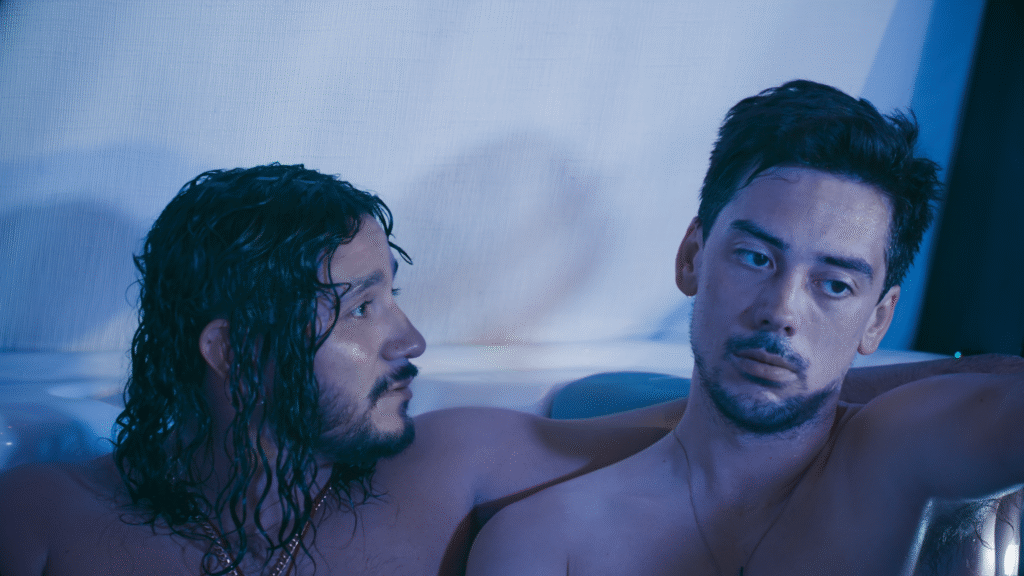
Escamilla wasn’t interested in grafting queer characters onto a familiar template. He wanted the relationship itself to reshape the film’s structure.
“I wasn’t interested in swapping in a gay couple just for representation,” he said. “I wanted their relationship, with all its complexity, to shape the tension and the emotional stakes.”
The film opens as a slow burn. Its early tone sits closer to The Strangers than to 1980s slashers. By the final act, that restraint gives way to full-throttle chaos. Escamilla described the structural shift as deliberate. Hollow Lake loses control as it goes. It mirrors the disintegration happening between its characters.
“By the time we hit the climax, it fully leans into those ’80s slasher vibes,” he said. “It gets more physical, more immediate, way more chaotic.”
What distinguishes this queer slasher from its influences is how it treats the home. For queer people, domestic space carries a particular weight. Safety and privacy aren’t simply a given. They’re negotiated and earned. A home invasion story told through that lens hits differently. The intrusion isn’t just physical, Escamilla said.
“There’s already that underlying feeling of being watched or judged or not fully safe,” he said. “So when something actually does happen, it just makes the whole thing feel more personal.”
Related Articles
Queer and Trans Horror Reclaims Fear on Screen
High heels, monsters & misfits: why queerness and campy horror are a perfect match
The Top 10 Most Scary Queer Horror Movies
The queer slasher: how one filmmaker is rewriting horror’s rules from the inside
Queer Horror: Moving Beyond the Genre Stereotype
Stranger danger through a queer lens
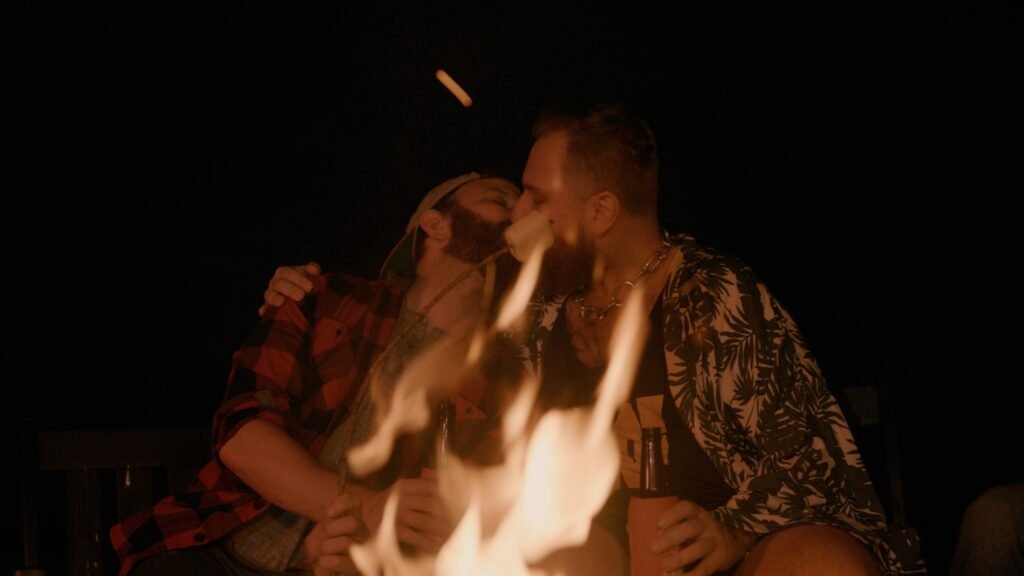
That layered vulnerability extends to how the film handles stranger danger. In queer spaces, people often connect with someone they don’t fully know. That’s especially true among gay men navigating hookup culture.
Escamilla didn’t want to over-explain that reality. Instead, he wove it into the film’s atmosphere. When a stranger enters Max and Baker’s space, the threat taps into something deeper than a masked figure at the door.
Who gets to tell these stories matters to Escamilla. Authentic queer horror doesn’t require every collaborator to be queer. His co-writer, Zach Shildwachter, is straight. But it does demand a willingness to let queer characters exist as full, complicated people.
“It’s not just about including queer characters,” he said. “It’s about letting them be messy, flawed, scared, even unlikeable at times. The genre is built on extremes, so flattening those characters kind of defeats the purpose.”
Does the queer slasher play for everyone?
The Toronto screening offered early proof that the approach works across audiences. Escamalia said the crowd was mostly straight, and he wasn’t sure how the film would land. But the response was immediate.
“They laughed in the right places, gasped where I was hoping they would,” he said. “You could feel them tracking the story beat by beat.”
That reaction aligns with Escamalia’s broader belief that specificity creates accessibility, not the other way around. A film rooted honestly in one experience doesn’t shut people out—it draws them closer. Audiences can feel when something is genuine, he said, and that honesty is what ultimately opens the door.
From Poltergeist to the queer slasher: a filmmaker’s origin story
Escamalia’s path to Hollow Lake began decades ago, in a movie theatre where his parents took him to see Poltergeist. He was terrified. He was also hooked. Weekend trips to video stores in the ’80s cemented the obsession—he was always in the horror section, drawn to the lurid VHS box art. The more films he made as an adult, the more he realized the stories that interested him most were rooted in his own perspective. Hollow Lake was the moment he stopped filtering that out.
He also co-hosts Dark Night of the Podcast with fellow horror filmmaker Roger Conners, a show launched during the pandemic in 2020 that has since produced nearly 200 episodes. Each installment offers a deep dive into a single horror film, from mainstream titles to deep cuts.
Hollow Lake is seeking more queer eyes and screaming audiences as it continues its festival run. But Escamalia isn’t chasing universal approval. He’s chasing something rarer: the feeling that lingers after the credits roll.
“I want people to leave feeling a little unsettled,” he said, “and still thinking about the characters. Not just what happened, but what it meant.”
The slasher genre spent decades mining queer fear without crediting the source. With Hollow Lake, the queer slasher isn’t borrowing anymore. It’s speaking for itself.