
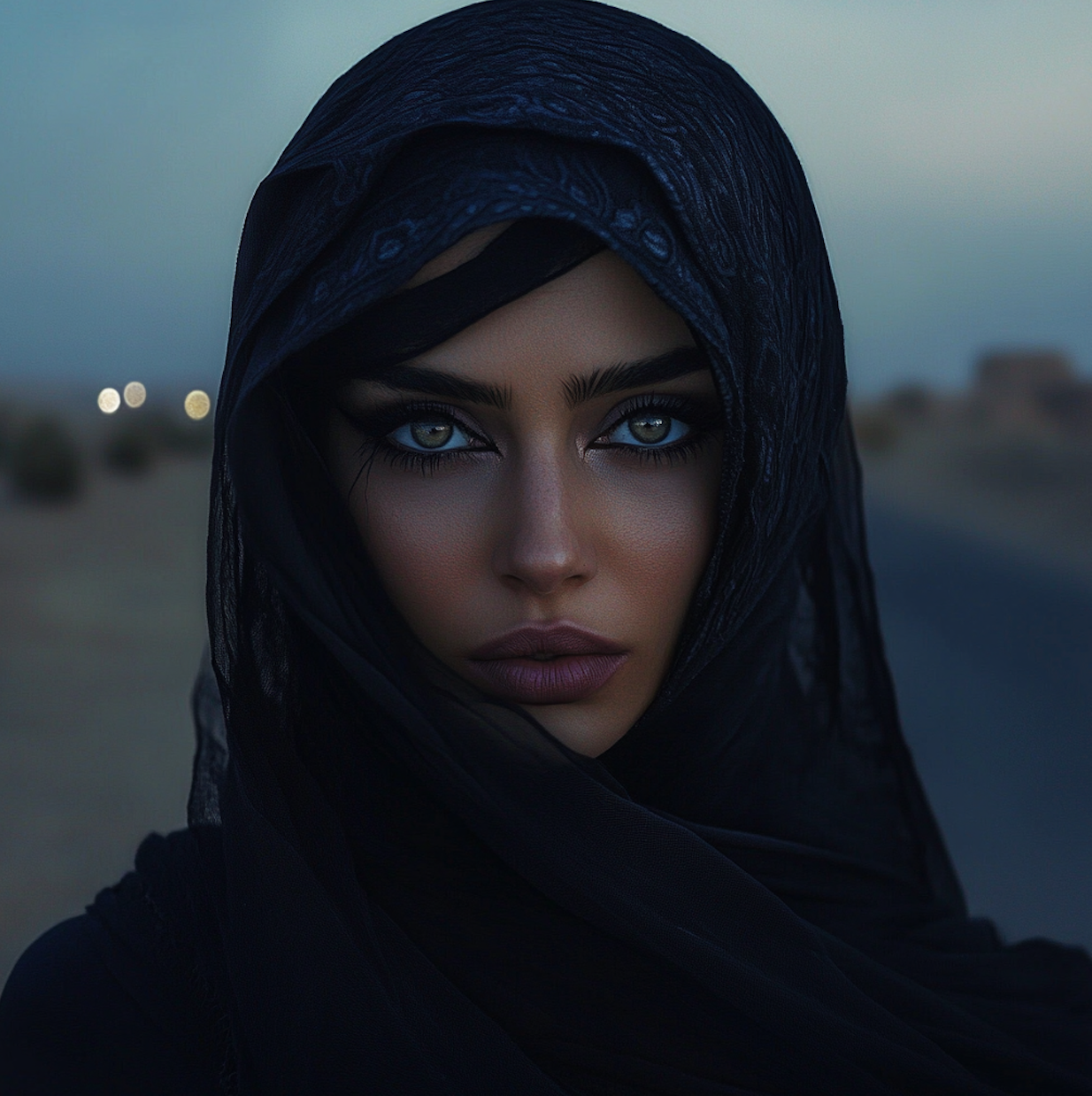
The perfume reaches you first. Oud in winter, musk in summer, sweet enough to pull a man off the road and into the dark.
That is how the old people in the Emirates describe the arrival of Umm Al Duwais. You smell her before you see her. By the time you see her, the story says, it is already too late.
She is the most famous spirit in Emirati folklore. A beautiful woman, alone at night, dripping with gold and good intentions. Under the robe, she hides blades. She uses them on the men foolish enough to follow.
This article is a long look at one of the Gulf’s most enduring legends. Where Umm Al Duwais comes from. What she is meant to look like. Why grandmothers still use her name as a warning. And why a new generation of Emirati women has started asking whether the monster of the story was ever the villain at all.
I have written before about the La Diablesse of Barbados, the Caribbean devil woman who lures men off lonely roads. Umm Al Duwais is her desert sister. The two have never met, yet they tell almost the same story across two oceans.
Table of Contents
Who is Umm al Duwais?
Before you can understand Umm Al Duwais, you need to understand the jinn.
In Islamic belief, the jinn are unseen beings created from smokeless fire. They live alongside humans but usually stay hidden. The Quran names them as a creation in their own right, neither angel nor human.
Jinn are not all evil. Like people, they can choose good or wrong, and God judges them for it. Many traditions say they live in tribes and societies of their own. On occasion, a jinn takes a physical shape that humans can see.
The jinn run all through the Quran, which gives them an entire chapter, Surah Al-Jinn. Pre-Islamic Arabs already feared and bargained with these spirits. Islam folded that older belief into its own view of creation.
Tradition sorts them into ranks. The strongest are sometimes called marid. The cunning, fiery ones are ifrit. The word shaytan marks a jinn turned fully to evil, in the orbit of Iblis himself.
Umm Al Duwais sits among the dangerous kind, but not the most powerful. She is no army-leading marid. She is a hunter, patient and personal, who works one foolish man at a time.
Most often, the stories say, a jinn appears as a snake, a scorpion or a lizard. Sometimes it takes a human form. That is where Umm Al Duwais comes in.
Related Articles
The Ghaf Tree has a Haunted History in UAE Folklore
The Haunted City of Madain Saleh
Desert Dread: How an Ancient Curse Spark A Saudi Arabian Horror
Embracing Shadows: The Horror of Writer & Director Nayla Al Khaja
A female jinn
She is a jinniyah, a female jinn, who wears the body of a stunning woman. Today she is the best-known jinn figure in the United Arab Emirates. Her fame has outlasted almost every other spirit in the region.
A female jinn was already a striking thing. Many of the most famous jinn in regional lore are male, or unnamed and sexless. Umm Al Duwais stands out as a spirit defined by womanhood, beauty and a woman’s grievances.
That is part of why she has aged so well. Her story was always about gender, power and desire. Those are exactly the themes a modern audience wants to dig into.
The name itself carries the warning. “Umm Al Duwais” is usually read as “mother of the little sickle” or “mother of the blade.” The word points to the cutting tools she is said to hide on her body.
You will see her name spelled many ways in English. Umm Al Duwais, Umm ul Duwais, Umm Duwais. In parts of Ras Al Khaimah, older residents call her Umm Al Das, or simply Mudas. The spellings change. The blades do not.
Her story belongs to oral tradition, not to any single written text. That matters. There is no official version of Umm Al Duwais, no founding document, no fixed origin. There is only what each family remembers and passes on.
That is the nature of folklore. Each teller adds a detail, drops another, and shapes the spirit to fit the fear of the moment. Umm Al Duwais has survived precisely because she bends.
The origins of Umm al Duwais
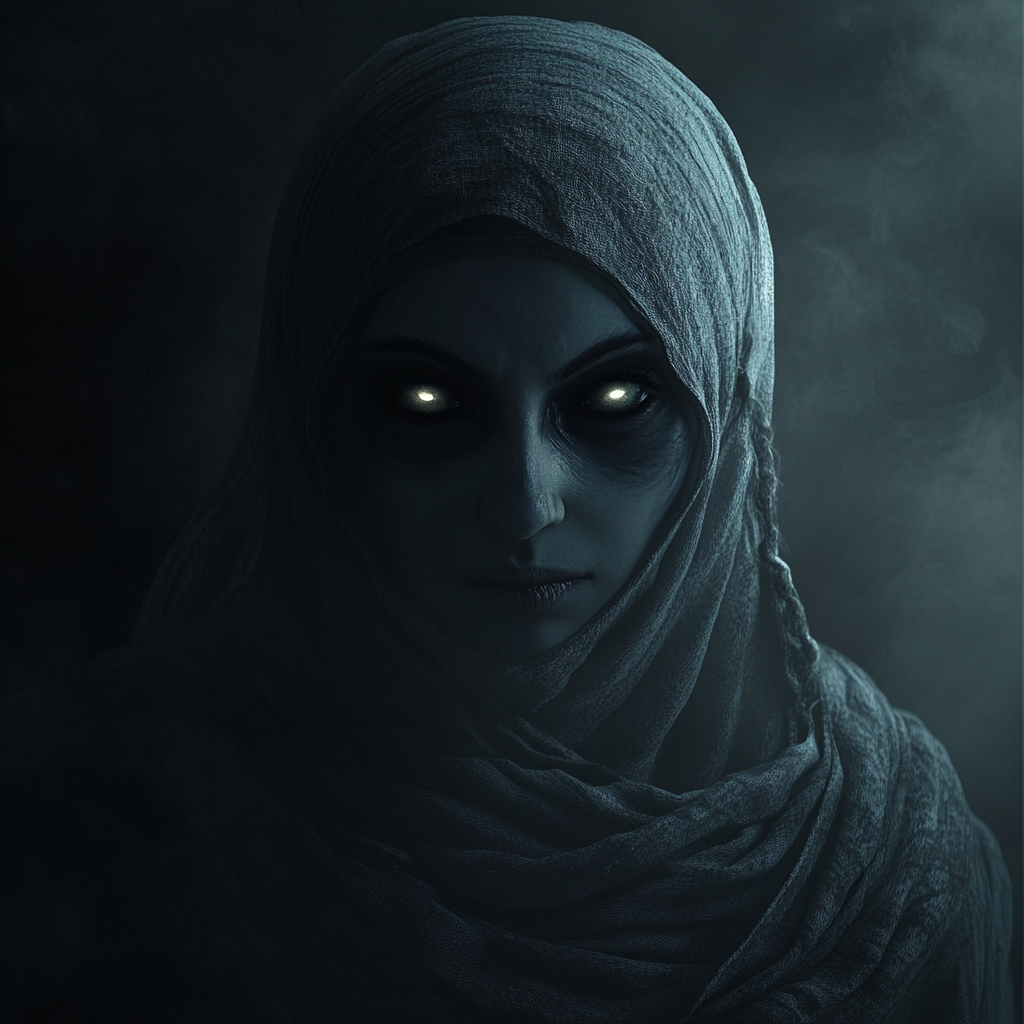
Elders are not sure how Umm Al Duwais first came to the Emirates.
Some folklorists suggest she may share roots with older figures from the wider region. The mythographer Marina Warner taught in Abu Dhabi and studied the area’s lore. She has noted that several pre-Islamic female figures from the Middle East were used to frighten children into good behaviour, as reported by The National. Umm Al Duwais sits within that long line.
Most accounts root her firmly in the desert and coastal villages of what was once the Trucial States. That is the cluster of sheikhdoms that became the UAE in 1971. Her legend grew in the years before oil, when nights were long, dark and genuinely dangerous.
Life then ran on pearling, fishing and the desert caravan. Men left home for weeks to dive for pearls or cross the dunes. The night belonged to wind, sand and whatever the imagination put out there.
A spirit like Umm Al Duwais made sense in that world. She gave shape to a real danger, the danger of a man alone, far from help, easy to mislead. The legend turned hard practical advice into an unforgettable story.
Keeping men in check
The Emirati writer Maitha AlSuwaidi, writing in Postscript Magazine, offers a clear-eyed reading of that origin. She describes Umm Al Duwais as a kind of scarecrow planted in the minds of restless young men.
The point, in that reading, was control. A spirit who hunted men at night gave families a powerful reason to keep their sons indoors after dark. Fear did the work that locks and curfews could not.
AlSuwaidi also records a darker origin tale told in her own family. In it, a desperate mother visits a witch for a potion to conceive a daughter. The child she bears is beautiful, but born with a full set of teeth and an appetite that never ends.
That girl, the story goes, eats the family’s food, then the family, then the whole town. She ends up alone in an empty, silent village. It is one of many threads that feed the larger legend.
Other versions skip the childhood entirely. They present Umm Al Duwais as a jinn who has always existed. She is older than the dunes, and she chooses the form of a woman to do her work.
The lesson of all these origins is the same. Do not trust beauty that finds you alone in the dark. The packaging changes. The warning holds.
Related Articles
Bukwas: The Wild Man of the Woods You Don’t Want To Meet
The Skinwalker: A Shape-Shifting Creature of Terror
Shadow People: Unveiling the Dark Figures of the Paranormal
What Umm al Duwais looks like
The descriptions agree on the surface and split on the horror beneath.
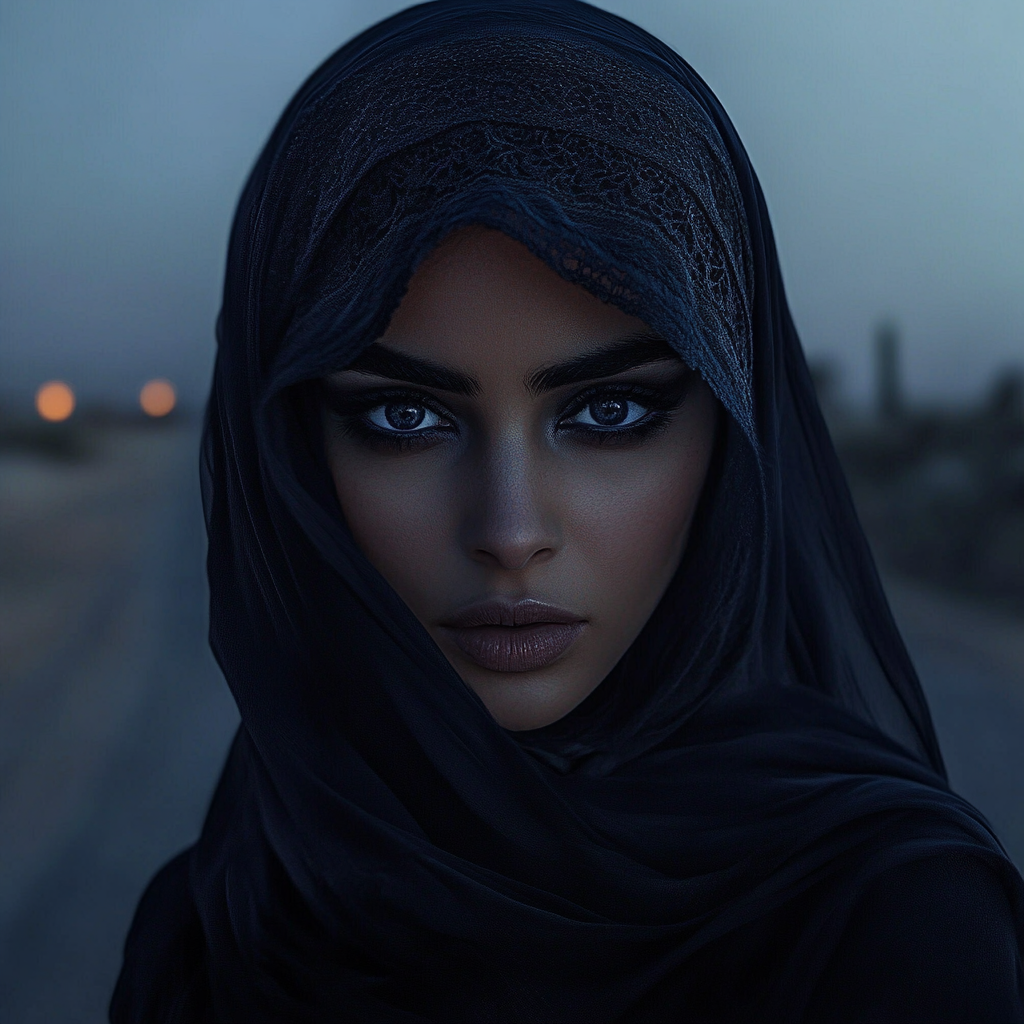
On the surface, she is flawless. Storytellers describe a slim, elegant woman with long black hair that falls past her waist. She wears traditional dress, fine fabric and heavy gold. Some say she shines under the moon.
She smells unforgettable. Oud, musk and rich Arabic perfume announce her from a distance. In Listverse‘s account, the scent carries far enough to reach a traveller long before she does.
She also sounds lovely. Many versions give her a soft, musical voice that calls out to passing men. The voice, the scent and the gold work together. No man, the elders say, is meant to resist all three.
Then the form breaks.
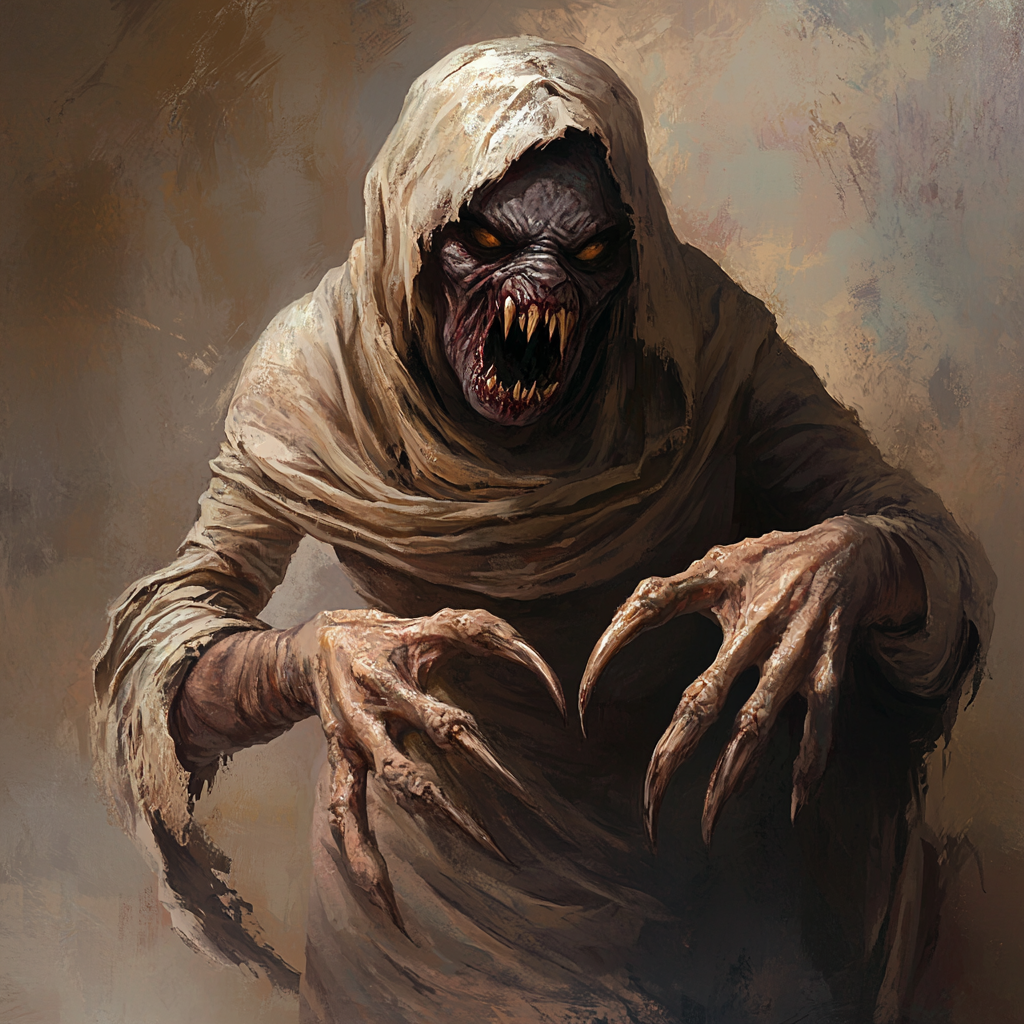
The National collects the classic markers in a single chilling line. The feet of a donkey. The eyes of a cat. Bladed hands. Hair black as night. Sweet perfume.
The blades are her signature. Depending on who tells it, her hands end in sickles, or her thighs are made of blades, or scythes grow where her limbs should be. She cuts the men who reach for her.
Feet that look like hooves
Her feet betray her too. Some say she has the hooves of a donkey or a camel, kept hidden under her abaya. In one account from Liwa, a man’s tethered camels woke with their hooves turned to scythes, the mark of her passing.
In other tellings, the beauty itself is the trick. A man approaches, and her face collapses into that of an old hag, or a skull lit from within. The fear lives in the gap between what he wanted and what he found.
The regional variants are worth noting. On the Arabian side of the Gulf, many versions give her camel legs hidden under the robe. Others give her donkey hooves, the older and more common detail.
Some tellings drop the legs entirely and make the blades themselves her lower body. In those versions, her thighs are sickles, and she folds a man in half when he embraces her. The image is brutal, and it is meant to be.
A few storytellers add cat eyes that catch the light, or hands that end in claws rather than sickles. Each teller keeps the parts that frighten them most. The blades, the scent and the false beauty survive in nearly all of them.
These details vary by village and by family. None is the “correct” version. They are the living edges of an oral tradition, and the disagreement is part of the point.
The sickle beneath the robe
The mechanics of the legend are simple, and that is what makes it stick.
Umm Al Duwais waits where men travel alone. The desert at night. A quiet road. The edge of a sleeping village. She appears as a woman in distress, or a woman simply too beautiful to ignore.
The man chooses to approach. That choice is the whole story. Umm Al Duwais does not chase. She lures, and she lets the man’s own desire carry him forward.
Then the trap closes. The perfume curdles, the face changes, and the blades come out. The man who strayed pays for straying.
A storyteller named Hanan summed up the function plainly to Khaleej Times. The tale exists, she said, to warn men against following beautiful strangers.
That warning had teeth in daily life. To this day, the same source notes, some Emiratis will compare a heavily made-up stranger to Umm Al Duwais. The comparison is rarely a compliment.
The double edge sword of Umm al Duwais
The legend also polices marriage. In many tellings, Umm Al Duwais targets the unfaithful above all. The husband sneaking out at night is exactly the man she is waiting for.
So she carries two jobs at once. She is a punisher of weak and disloyal men. She is also, quietly, a guardian of the household. Fear of her kept some men home and faithful.
The legend even shaped everyday language. Some Emiratis still use her name to judge a woman who wears heavy makeup and perfume. The implication is that such a woman is out to take other women’s husbands.
That usage cuts in an ugly direction. It turns a warning about male behaviour into a slur against women. The legend, like the spirit, has always had a double edge.
That double role explains her staying power. A spirit tied to a single trade or place tends to fade. A spirit tied to temptation and betrayal never runs out of work.
Encounters with Umm al Duwais
Ask older Emiratis about Umm Al Duwais, and many will hedge before they answer.
The women who gather to weave palm fronds at the National Theatre in Abu Dhabi all know her, The National reported. None claim to have met her. Each has a version, and each tells it as something heard, not seen.
One of them, Mouza Saeed, was born in Liwa and has lived in Abu Dhabi since the early 1960s. She describes a creature shaped like a woman but built like a lion inside. By her account, Umm Al Duwais eats almost anything, including animals and children.
Saeed adds a detail that gets overlooked. Umm Al Duwais does not only hunt men. She is said to deceive women too, knocking at the door disguised as a friend and coaxing them out of the house.
Her friend Afra Saqr offers the camel story. A man travelling by caravan to Liwa tied up his animals one night. By morning, their hooves had turned to scythes, and the women take that as a sign she had been near.
Saqr tells it calmly, weaving as she speaks. That calm is the texture of real folk belief. The terror is not performed. It is simply assumed, then set aside to get on with the day.
“God knows if it’s true”
The men of the old pearling village of Jazirat Al Hamra, in Ras Al Khaimah, keep a harsher version. One of them, Haider Al Qaidi, told the paper she would lead men far out into the night and use them.
In his telling, her thighs are made of blades, and she cuts the men she traps. He follows the story with the line that runs through almost every account of her. No one knows if it is true.
That phrase matters. “God knows if it’s true,” one elder said. The tellers do not insist on belief. They pass the story along and leave the judging to you.
The same elders say sightings have grown rare. Umm Al Duwais, they explain, prefers the open country to the lit-up city. As the desert filled with towns, she retreated to the spaces that still feel empty.
That detail is telling. The legend quietly admits its own decline, then refuses to die. She did not vanish. She simply moved further out, where the dark still wins.
Modern versions update the setting without changing the moral. One student adaptation has Umm Al Duwais seduce a married man by text message. The road has become a phone, but the warning is identical.
How do you survive Umm al Duwais?
Every good monster comes with rules for survival. Umm Al Duwais is no different.
The first rule is the simplest. Do not go out alone at night. Almost every version of the legend agrees that she hunts solitary men. Travel in a group, and she has no opening.
The second rule follows from the first. Do not follow a stranger, however beautiful, into the dark. The whole trap depends on the man’s choice to approach. Refuse the choice, and the trap never closes.
Faith offers its own defences. Across Islamic folk practice, reciting the Quran is the standard shield against hostile jinn. Verses such as Ayat al-Kursi, and the short chapters Al-Falaq and An-Nas, are recited for protection.
The point is not magic words. The point is composure. A man who keeps his prayer keeps his head, and a man who keeps his head does not chase perfume into the dunes.
Older folk belief adds physical charms. Iron has long been thought to repel jinn in Arabian tradition. Salt appears in many retellings as a protective substance carried by travellers.
None of these are guarantees in the stories. Umm Al Duwais is powerful, and a determined jinn is hard to stop. The surest protection was always behaviour, not a charm.
That is the quiet genius of the legend. Its survival rules are also rules for living well. Stay home at night, keep good company, resist temptation, and you will never meet her. Break those rules, and you are exactly the man she waits for.
Villain or vigilante? Reclaiming Umm al Duwais
Here the legend gets genuinely interesting, and here the original telling needs a correction.
For generations, Umm Al Duwais was simply a monster. The “wronged woman seeking revenge” backstory, the betrayed wife, the scorned beauty, is largely a modern addition. It is a reinterpretation, not the old core of the tale.
That reinterpretation is real and worth taking seriously. Much of it has come from young Emirati women.
Two filmmakers, Majida Al Safadi and Sarah Adel, retold her story for a course at the American University of Sharjah, The National reported. Their question was direct. What if Umm Al Duwais was simply misunderstood?
Their animated short plays the idea for dark comedy. Umm Al Duwais polishes her scythe, hides her donkey hooves under her abaya and brings fresh bread to the neighbours. She only loses her temper when a flirtatious married man insults her.
The students at Zayed University went further. Through their storyteller club, they made Umm Al Duwais their most popular character, often casting her as a kind of guardian of love. In their stories, she punishes the cheating husbands that real women fear.
One of them, Reem Khalid, told the paper she drew on true accounts of bad marriages. In that frame, the spirit is not the threat. The unfaithful husbands are.
The scholar Marina Warner places this shift inside two broader trends. One reclaims negative stereotypes of women and looks for the strength in them. The other restores the jinn to its older role as an ambiguous being, capable of good and ill.
Warner also makes a sharp point about desire. Lust, passion and seduction were long treated as female flaws. Increasingly, storytellers treat them as forms of power instead.
Islamic folklore and The Arabian Nights
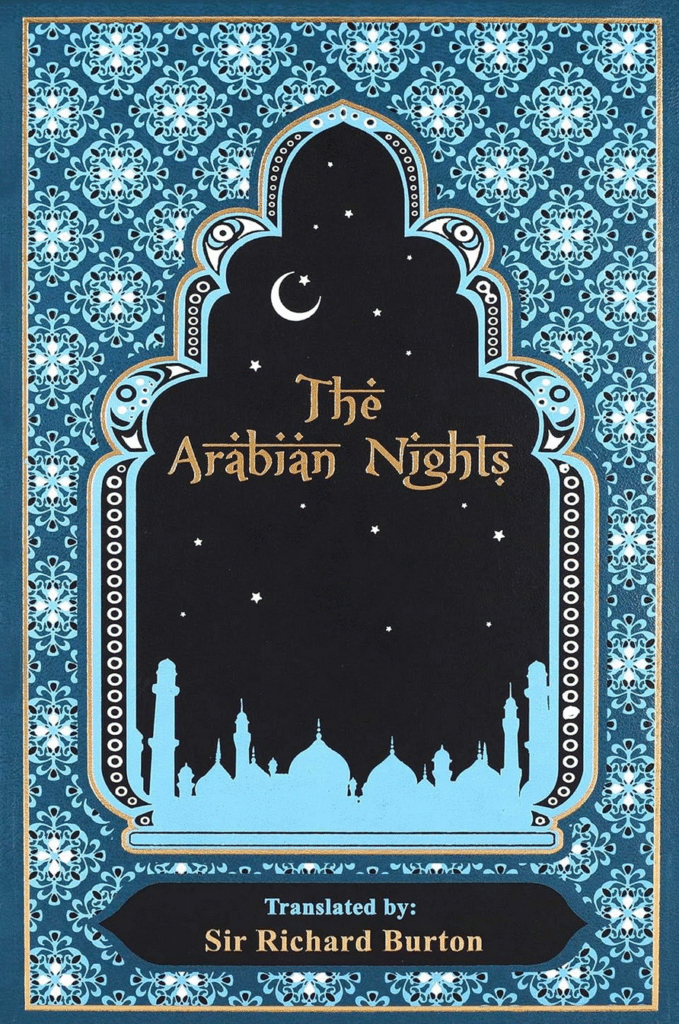
She ties this to a deeper feature of the tradition. Islamic folklore, and especially “The Arabian Nights,” is often more open about female desire than the old European fairy tales. Sleeping Beauty waits to be saved. The women of “The Arabian Nights” act.
Seen that way, Umm Al Duwais was never just a warning aimed at men. She was also one of the bold, dangerous, fully drawn women that the regional storytelling tradition has always made room for.
There is a real tension in all of this, and honesty requires naming it. The traditional legend can read as plainly sexist. It blames a woman, even a supernatural one, for the weakness of men.
The newer readings flip that logic. If Umm Al Duwais only cuts down liars and cheats, the women retelling her ask, is she truly the worst thing on that desert road?
I will not pretend to settle it. Both versions are alive at once. The cautionary monster and the avenging guardian now share the same name, and the same blades.
What the reinterpretation really changes is the point of view. The old tale watches Umm Al Duwais through the eyes of the frightened man. The new tales watch the man through her eyes instead.
That shift matters far beyond folklore. It is the same move that drives much of modern horror, where the so-called monster turns out to be the wounded party. Audiences increasingly ask who made the monster, and why.
Umm Al Duwais fits that mood perfectly. She is a woman blamed for male desire, then handed the power to answer it. No wonder a generation of Emirati women looked at her and saw something other than a warning.
None of this erases the older fear. For many families, she is still a genuine danger, not a feminist parable. Both truths sit side by side, the way they always have in living folklore.
Umm al Duwais on screen: The film “Djinn”
Umm Al Duwais also gave the UAE its first feature horror film.
In 2013, the country premiered “Djinn,” widely described as the first Emirati horror feature. It drew directly on the lore of Umm Al Duwais and the wider world of the jinn.
The director was a major name. Tobe Hooper made “The Texas Chain Saw Massacre” and “Poltergeist,” two of the most influential horror films ever made. “Djinn” would be his final completed feature before his death in 2017.
The film came from Image Nation Abu Dhabi, a leading Emirati production company. It was shot in the UAE, cast with Arab actors and performed in both Arabic and English.
The story follows a young Emirati couple who return home after losing their infant child. They move into a gleaming high-rise in Ras Al Khaimah and slowly realize their neighbours may not be human.
The setting carries real weight. The tower stands on the ruins of Jazirat Al Hamra, an abandoned pearling village long tied to jinn stories. Local lore holds that malevolent beings drove the villagers out.
Fear on the film set
The crew took the lore seriously. While filming in the old village, cast and crew reportedly avoided saying the word “djinn” out loud. They even covered the title on the director’s chair. Belief and superstition shadowed the shoot.
The film itself divided audiences. It premiered at the Abu Dhabi Film Festival to a sold-out crowd, yet many critics were unimpressed. Variety, among others, judged it a weak entry in Hooper’s career.
The road to release was long and strange. The film sat in post-production for years, with its premiere pushed back repeatedly from an original 2011 target. Industry rumours swirled the whole time.
Part of the delay was practical, part of it almost fitting. A film built on a spirit who refuses to be controlled took its own sweet time arriving. By the time it premiered, it carried the weight of years of anticipation.
Reception aside, “Djinn” did something lasting. It carried Umm Al Duwais and the Emirati jinn to an international audience for the first time. It proved the legend could anchor a modern screen story, not just a campfire one.
The other spirits of the Emirati night
Umm Al Duwais never haunted an empty country. She shared the dark with a whole cast of spirits.
The Emirati night had its own rules, and elders summed them up in a single phrase. The night, they said, does not belong to humans. After dark, the land passed to other tenants.
Out on the water lived bu Darya, a fearsome spirit of the Gulf. Pearl divers and fishermen told stories of him for generations. He belonged to the sea the way Umm Al Duwais belonged to the dunes.
Inland, lesser jinn guarded specific places and trades. One named Fatouh was said to watch over the mangroves, The National reported. Wells, groves and old ruins each had their unseen keeper.
These spirits did different jobs. Some guarded. Others punished. And others simply frightened children into bed. Together they mapped the whole landscape of Emirati fear.
Most of them have faded. Fatouh and his kind were tied to a way of life that modern cities swept away. The mangroves remained, but the keeper slipped out of memory.
Umm Al Duwais outlasted nearly all of them. She did it by attaching herself not to a place, but to a weakness. As long as men stray, her territory stays open.
That is why she still feels present in a country of towers and highways. The desert that bred her is mostly tamed. The temptation that feeds her is not.
A sister to La Diablesse
Umm Al Duwais is not alone. She belongs to a worldwide family of beautiful, deadly women.
The pattern repeats across cultures. A gorgeous stranger appears to a lone man at night. He follows. He does not come back. Folklorists find versions of this on nearly every continent.
The closest match in my own work is the La Diablesse of the Caribbean. She walks the dark road in a fine dress and a wide hat. Men chase her beauty until they spot the cloven hoof beneath her skirt.
The parallels are striking. Both women hide an animal limb. They punish lust and arrogance. And they also turn male desire into the weapon that destroys the man.
The differences are mostly costume. Umm Al Duwais carries sickles and the scent of oud. La Diablesse carries a hoof and the chill of the full moon. The moral engine underneath is the same.
You can find cousins everywhere. The succubus of European demonology. The sirens of Greek myth. The many “white lady” and weeping-woman figures who lure or drown the unwary.
A sibling to La Llorona
In Mexican folklore, La Llorona weeps for her drowned children and pulls the living down with her. Across the globe in the Philippines, beautiful spirits lure men off jungle paths. In Slavic tales, the rusalka draws men into the water. The faces change. The hunt repeats.
That shared shape tells us something true about people, not just spirits. Communities across history have feared the same thing. They have feared what desire makes men do when no one is watching.
These figures are also, almost always, about women. They reflect old anxieties about female beauty and female power. That is why the modern Emirati reclaiming of Umm Al Duwais feels so timely.
If you enjoy this kind of folklore, the Caribbean is full of it. My piece on the Ti-Bolom of Saint Lucia explores another spirit summoned and set to work, much as the jinn are in the Gulf.
The lesson of the whole family is consistent. Beauty alone at night is a question, not a gift. The wise answer, in every culture that tells these tales, is to keep walking.
Umm ul Duwais in art and imagination
A legend stays alive only if each generation finds a use for it. Umm Al Duwais keeps finding new ones.
Writers have begun to claim her as a heritage symbol. In Postscript Magazine, the Emirati author Maitha AlSuwaidi describes thinking about the spirit constantly. She imagines her not as a beast, but as a reader haunting an abandoned mansion.
In that essay, Umm Al Duwais becomes almost sympathetic. AlSuwaidi pictures her between hunts, working through books and leaving her own writing behind. The monster turns into a mirror for a young woman navigating her place in the world.
AlSuwaidi is honest about the legend’s old purpose. She calls Umm Al Duwais a scarecrow, fabricated to keep restless young men off the streets at night. Naming the trick does not break the spell. It deepens it.
The student filmmakers go a step further into reinvention. Their shorts give Umm Al Duwais a personality, a sense of humour and a grievance. They let her speak, which the old tales never did.
Visual artists keep returning to her too. The contrast at the heart of her, gorgeous face and hidden blade, is a gift for any illustrator. She is built for the striking single image.
This creative afterlife is the modern half of an old process. For centuries, oral storytellers reshaped her by voice. Now writers, animators and artists reshape her in print and on screen. The tools changed. The reshaping did not.
There is something fitting in all of it. A shape-shifting jinn was always going to be a shape-shifting symbol. She slips from warning, to heritage, to feminist hero, and never quite lets you pin her down.
Why Umm al Duwais still walks the desert
Most local jinn faded as the Emirates modernized. Umm Al Duwais did not.
The National noted that her contemporaries were often tied to a place or a trade. Fatouh guarded the mangroves. Others guarded wells or trades. As those things vanished, the spirits attached to them slipped out of memory.
Umm Al Duwais was tied to something that never goes out of date. Temptation. Betrayal. The trouble that follows desire. Those fears travel from the desert into the city without losing any of their force.
So she adapted. She moved from caravans to highways, from whispered campfire warnings to text messages and short films. The vehicle keeps changing. The spirit rides along.
She also serves a new purpose now. For artists, writers and filmmakers, she has become a symbol of Emirati heritage, a thread back to a pre-oil world of oral storytelling. Telling her story keeps that older world alive.
For young Emirati women in particular, she has become something more. She is a figure to argue with, rewrite and reclaim. A monster handed down by the past, remade into a mirror for the present.
That is the real reason she endures. Umm Al Duwais is flexible enough to be a warning, a heritage symbol and a feminist hero at the same time. Few legends carry that much weight.
A lesson in the dangers of beauty
It helps that the legend never demanded belief. The elders always added that God alone knows if it is true. That humility kept the story safe from disproof. You do not have to believe in Umm Al Duwais to feel the pull of her warning.
There is a deeper reason too. She speaks to something every culture knows. The fear that beauty can hide a blade. The fear that desire can lead a person somewhere they cannot return from. Those fears do not retire.
So she lingers at the edge of the modern Gulf, half forgotten and never quite gone. She lives in a line a grandmother drops to a sleepless child. She lives in a student’s short film, a magazine essay, a horror feature with a famous director’s name.
So treat the old advice with respect, even now. If you find yourself alone in the desert at night, and a beautiful woman calls to you in a soft voice, do not go.
The perfume will reach you first. By the time you see the blades, the story says, it is already too late.