
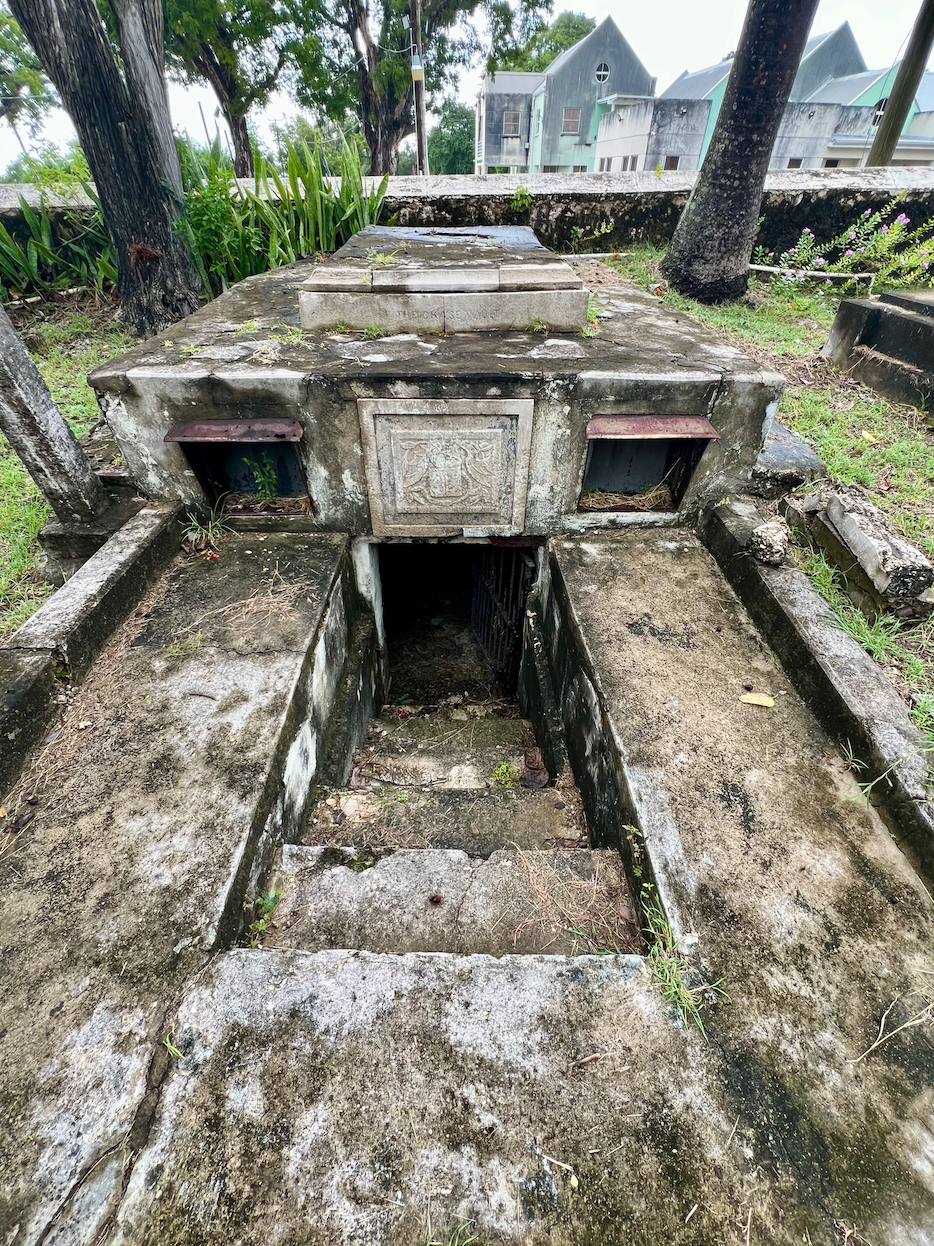
The Origins of the Chase Vault in Christ Church Parish
Builders constructed the Chase Vault in 1724 in Christ Church Parish, where it sits flanked by the rich greenery of the churchyard. The Chase family, a lineage known for their prominence in colonial Barbados, commissioned the tomb for their own use. Unlike typical graves, builders crafted the Chase Vault from heavy stone to house multiple members of the same family, and sealed its entrance with a colossal slab of blue limestone.
Initially, the vault lay quiet, its air thick with sombreness of death.
But in 1808 according to most sources, an apparent disturbance began when workers reopened the vault to receive its first known interment.
The First Signs of Unrest at Chase Vault
Workers buried Thomasina Goddard first in the Chase Vault. Her arrival passed without incident, leaving the site undisturbed. The vault’s tale took a chilling turn only when the infamous Colonel Thomas Chase died in 1812.
Heavy emotion marked Colonel Chase’s burial. Many did not mourn his passing, since they knew him as a strict and sometimes cruel plantation owner. When workers opened the vault for his interment, the scene played out routinely, except for the creeping discomfort that followed in the months to come.
The Disturbance Begins at Chase Vault
A year later, workers opened the vault again for the burial of Dorcas Chase, Thomas’ young daughter. As they shifted the limestone slab, the crowd is said to have gasped in terror.
The coffins inside no longer sat in their original positions. Onlookers found Thomas Chase’s coffin, remarkably heavy and lead-lined, tipped against the far wall, as if someone had thrown it.
Suspicion brewed. Initially, many assumed the disturbance was an act of vandalism or a cruel prank, but the vault’s robust stone construction and undisturbed seal made tampering unlikely. It was a puzzle that defied logic, one that only deepened with the next burial.
Related Articles
If Looks Could Kill: The Diablesse of Barbados
The Story of Heart Man: Barbados’ darkest folklore
The Duppy of Barbados: The Island’s Haunting Spirits
The Steel Donkey: Barbados’ Clanking Phantom of the Night
The Haunted George Washington House
The Ti-Bolom: Saint Lucia’s Little Man Who Works for the Devil
Horror Short Film, All Skin No Laugh, rooted in Caribbean Folklore
A Pattern of Chaos at the Cemetery
In 1816, mourners were to lay Samuel Brewster’s body to rest alongside the other Chase family members. As they approached the tomb, an air of trepidation enveloped them. They pried open the limestone door with great effort, revealing an even more chaotic scene: all the coffins lay in disarray, tossed about like ragdolls.
Panic crept in. The coffins had shifted, yet the vault remained intact, its walls free from cracks or signs of forced entry. By this time, the tale of the moving coffins had spread across the island, capturing the attention of Governor Lord Combermere, who would later lead an investigation to determine the source of the disturbances.
The Governor’s Examination of Chase Vault
Governor Combermere ordered workers to replace the coffins in an orderly fashion. To rule out human interference, he had them spread fine sand across the floor of the tomb to record any footprints. Workers sealed the vault once more, and the governor and his team awaited the next incident with tense anticipation.
When the vault was reopened in 1819 for the burial of Thomasina Chase’s relative, the scene was one of horror. The heavy coffins had shifted once more, some overturned, others propped at unnatural angles. Yet the sand showed no sign of disturbance, and the seal remained unbroken.
Theories and Supernatural Speculation
The Chase Vault’s unnerving events sparked widespread debate. Local folklore suggested that the souls of the Chases were tormented, punished for Colonel Thomas Chase’s cruelty.
Some whispered that Dorcas Chase, who had reportedly died by suicide following a troubled life under her father’s roof, brought with her an unearthly vengeance.
Beyond spiritual interpretations, others sought rational explanations. Geologists posited that underground water could have shifted the coffins, but the structure’s solid foundation made this theory tenuous.
Earthquakes were also considered but ruled out due to the absence of other affected structures nearby.
Over the years, the mystery endured, amplified by the chilling reality that each time the vault was opened, it echoed the same story: displaced coffins without an apparent cause.
The Final Sealing of Chase Vault in Barbados
In the wake of continued disturbances, the Chase Vault was permanently sealed. Its legend, however, continued to roam free. To this day, it stands as a scary reminder that some stories defy both time and logic, resting in the uneasy space between fact and the inexplicable.
The tale of the Chase Vault invites one persistent question: was it the work of angry spirits, an arcane phenomenon, or a hoax steeped in grief?
Perhaps it is this unsolved puzzle that lends the vault its lasting power—a chilling mystery amid the gravestones.