
What Is the Steel Donkey?
A metallic clanking sometimes breaks the silence of rural Barbados. It arrives as iron scraping against iron. The sound rolls across sugar cane fields swaying in the tropical breeze. For generations, this noise has meant one thing to Bajans: the steel donkey has come out.
The steel donkey ranks among the island’s most feared folkloric entities. Older Barbadians still tell stories about it with real caution. Younger generations hear the tale from grandparents, parents, and neighbours. The creature roams back roads and remote parishes. It has earned a permanent place in Caribbean horror lore.
This article traces the steel donkey’s origins, its appearance, and its documented sightings. It explores why the legend endures, even as belief in the supernatural fades across the region. It also places the steel donkey beside its Caribbean cousins, since Barbados does not hold a monopoly on clanking, fire-breathing phantoms.
The Origins of the Steel Donkey in Barbadian Folklore
The steel donkey’s story traces back to the early 20th century. Its roots likely run older. Communities passed the tale down orally, long before anyone wrote it down. Belief in spirits and curses shaped daily life across rural Barbados for generations.
According to Go Barbados, the creature emerged from a specific superstition. Bajans believed a person could place a curse on an enemy. The steel donkey served as that curse made manifest. A wronged party summoned the creature to torment whoever had caused the harm.
This origin story gives the legend a moral shape. The steel donkey did not attack at random. It targeted people whom someone else believed deserved punishment. Historians who study Caribbean folklore see this as a form of social commentary. The tale cautioned against greed, cruelty, and envy within tight-knit communities.
Sugar plantations dominated Barbadian life when the legend took hold. Enslaved Africans and their descendants carried spiritual traditions across the Atlantic. Those beliefs merged with local customs and Christian teachings over time. The steel donkey grew out of that same cultural blend that produced so much of the island’s folklore.
Related Articles
If Looks Could Kill: The Diablesse of Barbados
The story of Heart Man: Barbados’ darkest folklore
A Tale of Moving Coffins in Barbados (Chase Vault)
The Duppy of Barbados: The Island’s Haunting Spirits
The Haunted George Washington House
The Ti-Bolom: Saint Lucia’s Little Man Who Works for the Devil
Horror Short Film, All Skin No Laugh, rooted in Caribbean Folklore
What Does the Steel Donkey Look Like?
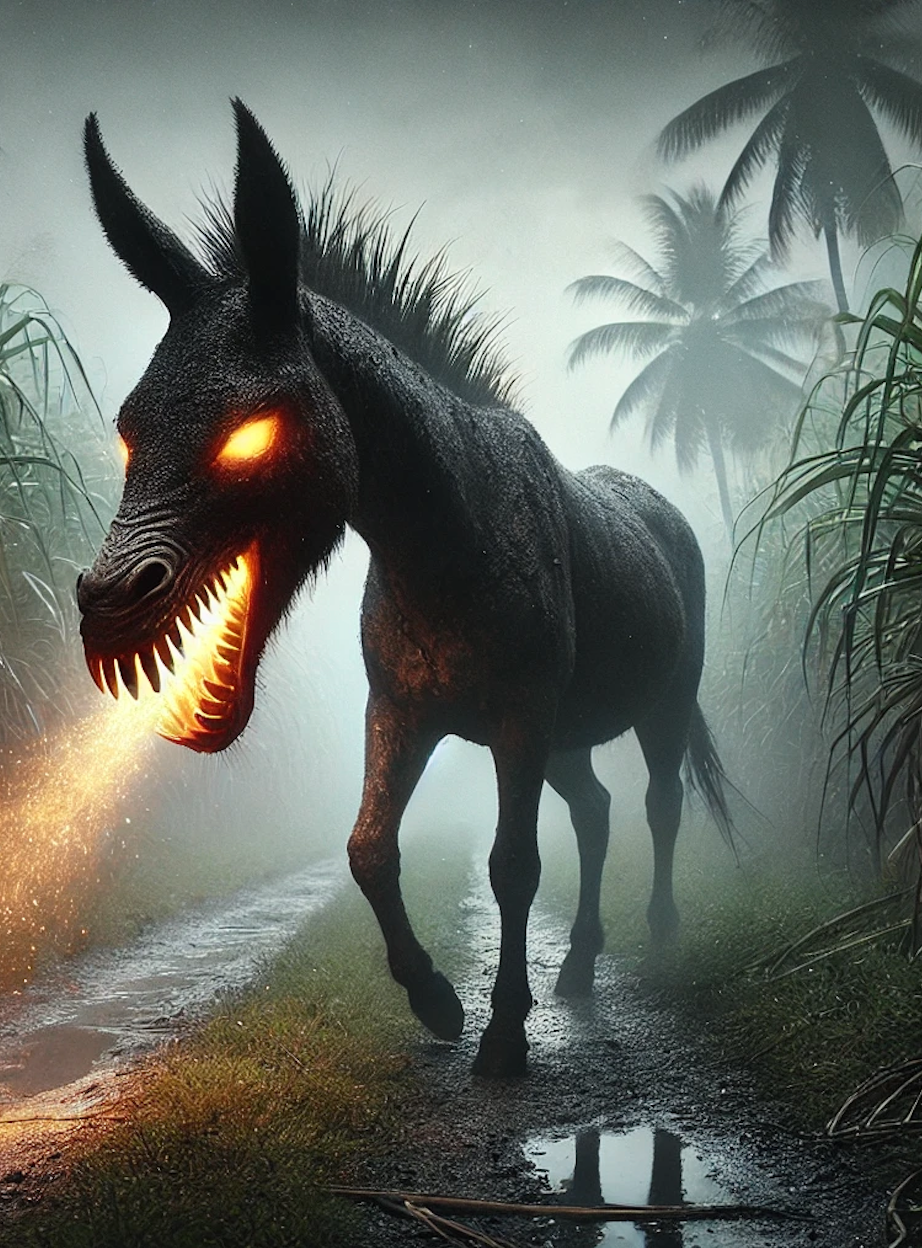
Descriptions of the steel donkey stay remarkably consistent across the island. Locals describe a demonic donkey built from metal. Its eyes burn like fire. Its mouth releases flames with every breath.
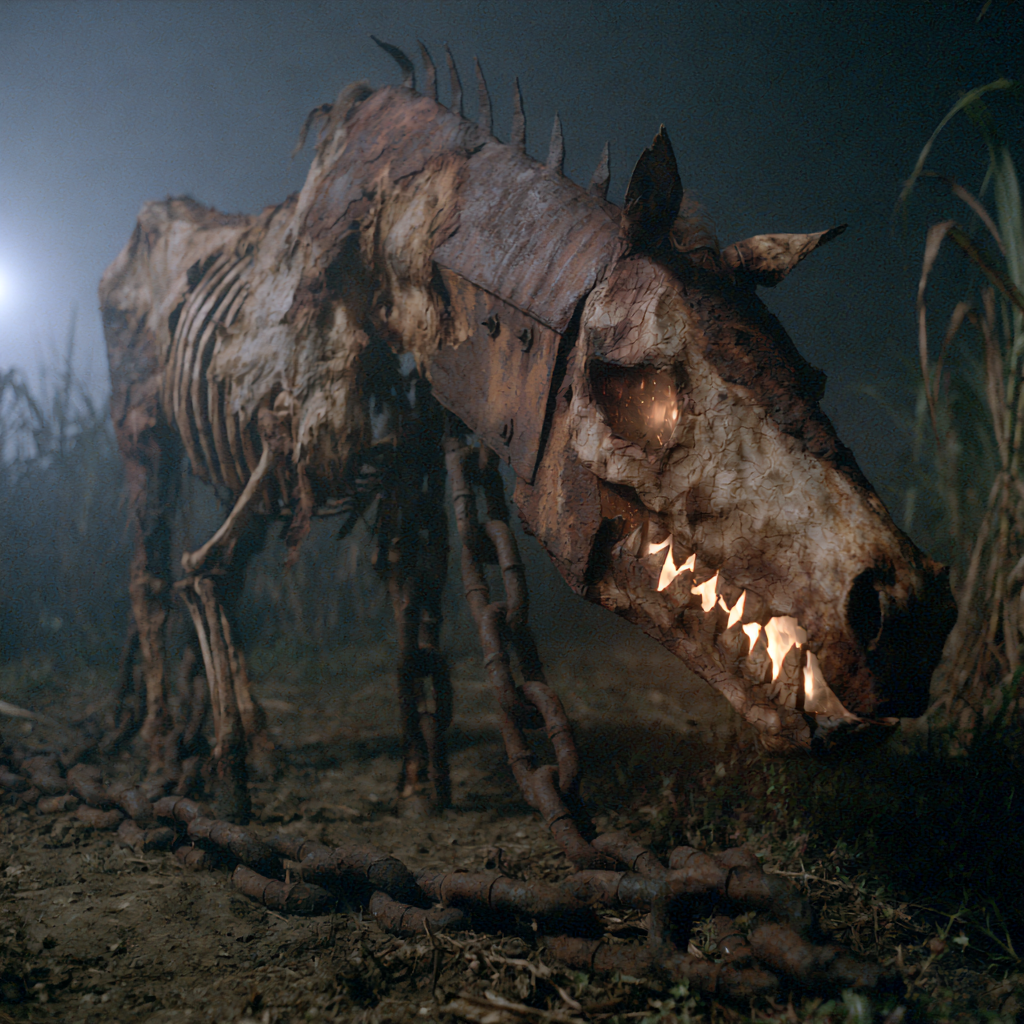
The clank of dragging chains announces its arrival before anyone sees it. That sound has become the creature’s signature, according to the Bajan Arts & Culture platform Gine On?!. Some storytellers add more detail. One well-known artistic interpretation gives the steel donkey a hybrid skeleton. Steel grows outward through its body, as if the curse itself deformed the creature over and over.
That version frames the steel donkey as a tormented soul. It curses others with harmful intent, then suffers a fresh curse in return. The cycle repeats endlessly, according to that telling. Some accounts even equip the creature with a Bajan slingshot, called a guttaperk, loaded with a molten stone.
Not every witness agrees on the details. Some describe a straightforward donkey with glowing eyes and a chain. Others insist on the more elaborate, half-human hybrid. That inconsistency is common in oral folklore. Stories shift as they pass from person to person across decades.
Sound plays as large a role as sight in most accounts. Witnesses often describe hearing the steel donkey long before they see it, if they see it at all. The clanking chain travels across open fields and along quiet roads. That auditory warning gives the legend much of its dread, since a listener cannot always tell how close the creature has come.
Smell and heat sometimes enter the descriptions too. A few tellings mention a scorched, metallic odour that lingers after an encounter. Others describe a wave of heat rolling off the creature’s body, consistent with its fire-breathing reputation. These sensory details vary by storyteller, parish, and generation, but they consistently reinforce one theme: the steel donkey announces itself through more than appearance alone.
Reported Sightings and Strange Occurrences
Sightings of the steel donkey rarely stay simple. Witnesses often report strange events alongside the creature’s appearance. Stones sometimes pelt rooftops with no one nearby to throw them. Livestock falls ill without explanation. Hoofprints appear on dusty paths that lead nowhere.
These details matter to believers. They treat the phenomena as evidence, not coincidence. A sudden hailstorm of stones on a tin roof becomes proof the steel donkey has passed through. Sick animals confirm that someone, somewhere, invoked the curse.
Locations shift too. The creature has reportedly appeared in Silver Sands one week and near Bay Street the next. Neither counts as a remote, rural area. That mobility adds to the mystery. Nobody can predict where the steel donkey will surface.
The Barbadian calypso group The Merrymen once captured this uncertainty in song, noting how half the island swore they had seen the creature. Yet accounts of its exact form rarely matched. That contradiction sits at the heart of the legend. Everyone knows the steel donkey. Few agree on precisely what it is.
How the Steel Donkey Connects to Barbadian Beliefs About Cursing
Cursing beliefs run deep in Barbadian folk history. Communities once treated envy and malice as forces with real, tangible power. A person who wronged a neighbour risked more than gossip. They risked supernatural retaliation.
The steel donkey gave that fear a shape. It offered a concrete image for an abstract threat. Rather than simply saying someone had been cursed, storytellers could point to hoofprints, chains, and fire. The creature made an invisible danger visible.
This function places the steel donkey alongside other Caribbean folk figures built around punishment and warning. The Heart Man, another Barbadian legend, reportedly sought out misbehaving children. Parents invoked his name to enforce good behaviour, much as they used the steel donkey to warn against wandering after dark.
Folklore like this served a practical purpose in rural communities. It reinforced social norms without requiring formal law enforcement. Fear of supernatural consequences kept people cautious about who they wronged and how they behaved after sunset.
The Steel Donkey and Barbados’ Wider Folklore Tradition
Barbados packs an outsized amount of folklore into a small island. The steel donkey shares the stage with jumbies, mischievous spirits blamed for minor household chaos. It shares the stage with the Heart Man, a far more menacing figure tied to punishment.
These tales do not exist in isolation. They surface in festivals, songs, and everyday conversation. Crop Over, the island’s best-known cultural celebration, grew out of the plantation-era sugar cane harvest and blends African and Caribbean traditions through music and storytelling. Folk figures like the steel donkey belong to that same living cultural fabric.
Storytelling has long served as entertainment and instruction in Barbados. Grandparents told these tales at night, when there was little else to do before bed. Children absorbed both the fright and the lesson embedded in each story. The steel donkey carried a caution about envy. The Heart Man carried a caution about misbehaviour.
That dual function, part entertainment and part social guardrail, explains why these legends survived so long. They gave communities a shared language for discussing right and wrong, wrapped in a frightening, memorable package.
How the Steel Donkey Compares to Jamaica’s Rolling Calf
The steel donkey does not stand alone in Caribbean folklore. Jamaica has its own version of a clanking, fire-eyed night terror: the Rolling Calf. According to A Book of Creatures, this duppy, or spirit, shares nearly every trait with the Barbadian legend.
Both creatures drag chains behind them, both burn with fiery eyes, and both haunt lonely roads at night. Jamaicans generally describe the Rolling Calf as the spirit of a cruel man, often a butcher, punished after death for his wickedness in life.
Barbadians frame the steel donkey slightly differently, tying it more directly to an active curse than to a specific dead man’s afterlife. Even so, the overlap is striking. Storytellers across the wider Caribbean region drew on shared West African spiritual traditions, particularly beliefs about duppies and the restless dead.
Similar legends appear elsewhere in the region too. The May Cow haunts Cayman Brac during the month of May. Trinidad’s own folklore includes fire-breathing, chain-dragging spirits with comparable roots. Together, these tales form a regional pattern rather than an isolated Bajan curiosity.
The Steel Donkey in Barbadian Cane Fields and Rural Life
Barbados built its colonial economy on sugar cane, and the steel donkey grew directly out of that rural landscape. Cane fields covered vast stretches of the island for centuries. Isolated tracks and pastures cut between them, exactly the kind of terrain the legend claims as its territory.
Rural Barbadians worked long hours under harsh conditions during the plantation era. Storytelling filled the evenings once the work stopped. Fear of the steel donkey likely discouraged wandering alone at night, whether toward mischief or toward danger from other people.
The creature’s connection to the land runs deeper than simple setting. Some tellings link the steel donkey to overgrown pastures and abandoned tracks specifically. A person walking through thick bush, away from main roads, faced the highest risk of an encounter, according to tradition.
That rural anchor has shifted somewhat as Barbados has urbanized. Fewer people work the cane fields today than a century ago. Yet the legend has not vanished with the plantations. It has simply adapted to new settings.
Why the Steel Donkey’s Legend Faded, and Why It Persists
Belief in the supernatural declined across Barbados as the island modernized. Electricity, paved roads, and formal education chipped away at the conditions that once let legends like the steel donkey thrive in the dark. The once-dreaded figure became less of a nightly terror.
Yet the story did not disappear. It evolved instead. Contemporary tellings sometimes place the steel donkey near sites tied to transformation or decay, including the Mangrove landfill in Saint Thomas parish. The creature adapted to Barbados’ changing landscape rather than fading with it.
Cultural memory plays a role in that survival. Older Barbadians pass the tale to younger generations, even when fewer people claim direct sightings. The story now functions more as heritage than as an active warning against specific behaviour.
Nostalgia and identity matter here too. Bajans returning to rural roads sometimes pause when wind rustles through cane fields nearby. For those who grew up with the tale, a faint clink of metal in the distance can still raise the hair on their arms.
The Steel Donkey in Modern Barbadian Culture
The steel donkey has moved well beyond oral storytelling in recent years. Local artists have reimagined the creature visually, giving it new textures and details for contemporary audiences. Some renderings emphasize its hybrid, half-animal skeleton. Others keep the classic donkey silhouette with glowing eyes.
Publishing has picked up the legend too. Author Kandace Chimbiri wrote The Steel Donkey: A Tale from Barbados, a children’s book from Hodder Education’s Reading Planet series. The story follows a young girl named Akeenah, who must escape the creature’s nightly visits to her family home in Elverton.
That kind of adaptation shows how folklore travels across generations and formats. A story once told by firelight in rural Barbados now reaches classrooms and young readers through printed pages. The core details survive the transition: the chains, the fire, the fear of the dark.
Social media has extended the steel donkey’s reach further still. Short clips and posts introduce the legend to audiences well outside Barbados, often for the first time. The creature that once haunted specific parishes now circulates internationally, carried by curiosity rather than fear alone.
Folk Traditions: How Bajans Describe Escaping the Steel Donkey
Caribbean duppy lore generally comes packaged with escape tactics. Storytellers rarely leave a listener defenceless against the creature they just described. The steel donkey fits that same pattern, even if Barbadian sources describe fewer specific countermeasures than some neighbouring legends.
Jamaica’s closely related Rolling Calf offers the clearest comparison. Storytellers there describe several classic defences. A person can drop small objects on the ground for the creature to count, since duppies reportedly cannot count past three. Reaching a crossroads before the creature arrives supposedly breaks its pursuit. Some tellings mention a pen knife driven into the earth as a barrier.
Bajan tellings of the steel donkey lean more heavily on prevention than escape. Avoiding overgrown pastures and remote tracks after dark ranks as the most common advice. Staying close to home and avoiding conflict with neighbours addresses the legend’s underlying warning about curses and ill will.
That difference matters. The steel donkey ties directly to a wronged party summoning supernatural punishment. Its narrative purpose leans toward deterrence rather than survival tactics. The lesson sits upfront: treat your neighbours fairly, or risk becoming the target of a curse made flesh and iron.
The Steel Donkey and the Legacy of Plantation-Era Barbados
Barbados carries a complicated colonial history, and the steel donkey cannot be separated from it. The island became one of the world’s largest sugar producers by the 18th century. That economy depended entirely on enslaved African labour working under brutal conditions.
Enslaved people and their descendants carried spiritual practices, storytelling traditions, and cosmologies from West Africa across the Atlantic. Those beliefs did not disappear under plantation rule. They adapted, blended with Christian teachings, and produced a distinctly Caribbean body of folklore.
Chains appear again and again across this folklore, from the steel donkey’s dragging metal to the Rolling Calf’s own clanking bonds. Some scholars and storytellers read that recurring image as more than coincidence. The chain evokes bondage directly, transformed into a symbol of guilt, punishment, and haunting that outlives the era that produced it.
Viewed this way, the steel donkey carries weight beyond a simple ghost story. It reflects a community’s effort to process cruelty, injustice, and power imbalance through supernatural narrative. Sugar cane fields, the literal site of that history, remain the legend’s setting to this day.
Frequently Asked Questions About the Steel Donkey
What is the steel donkey? The steel donkey is a Barbadian folklore creature. Storytellers describe a metal, fire-breathing donkey that drags chains through rural parishes at night.
Where did the steel donkey legend come from? The legend traces to the early 20th century, rooted in older Bajan beliefs about curses. Communities believed a wronged person could summon the creature against an enemy.
Is the steel donkey the same as Jamaica’s Rolling Calf? The two share close similarities, including chains, fire, and nocturnal habits. Barbadians and Jamaicans developed the legends separately, though both draw on shared West African spiritual traditions.
Where do people report seeing the steel donkey? Sightings historically cluster around rural parishes and back roads. Reports also place the creature in areas like Silver Sands and Bay Street, and more recent tellings tie it to the Mangrove landfill in Saint Thomas.
Does anyone still believe in the steel donkey today? Belief has declined as Barbados has modernized. The legend persists mainly as cultural heritage, passed down through families, books, and social media rather than through direct, widely claimed sightings.
Why the Steel Donkey Still Matters Today
Folklore like the steel donkey does more than entertain. It preserves values and fears that shaped earlier generations of Barbadians. The tale reflects real anxieties about envy, cruelty, and the consequences of wronging one’s neighbours.
Technology has disconnected many people from traditional beliefs. Streetlights replace darkness. Phones replace firelight storytelling. Yet legends like the steel donkey survive precisely because they carry more than superstition. They carry heritage.
For many Bajans, these stories function as a bridge to the past. They connect present-day islanders to ancestors who lived through plantation-era hardship and built spiritual frameworks to make sense of it. The steel donkey embodies that history in a single, unforgettable image.
The legend endures because it taps into fears that never fully disappear: the power of community judgment, the mystery of the unseen, and the consequences of ill will. Barbadians may no longer fear literal encounters on dark roads. Many still recognize the steel donkey as a defining piece of their island’s identity.
Researchers who study Caribbean oral tradition often point to this durability as evidence of folklore’s real function. Legends like the steel donkey rarely survive centuries by accident. They survive because each generation finds something useful in them, whether a warning, a shared identity, or simply a good scare on a dark night. The steel donkey has done all three jobs at once for well over a hundred years.
Some nights, the wind still moves through what remains of the island’s cane fields. For those who know the story, a faint metallic clink carried on that breeze can still send a chill down the spine. The past, on this island, is never quite as far away as it seems.