
A jumbie is a spirit in Caribbean folklore. The word covers a crowd of beings, from the faceless douen of Trinidad to the bottled baccoo of Guyana. Some jumbies are the restless dead. Others are forest creatures with their own rules.
This guide introduces four jumbies from Creepy Current’s reels: the douen, the moongazer, the baccoo and the bush dai-dai. It sits within our wider guide to Caribbean folklore.
What Is a Jumbie?
Jumbie, also spelled jumbee or jumby, is a broad word for spirits in Trinidad, Guyana, Antigua and other islands. Tellers use it for ghosts, demons and forest beings. Duppy and mendo are close synonyms in some places.
Some people believe an especially wicked person becomes a jumbie after death. Others see jumbies as demons. The folklore agrees on one point: jumbies cause trouble after dark.
Protections vary. One widely repeated belief says jumbies cannot resist counting. People leave rice or sand by the door so the spirit stops to count every grain until dawn.
The Douen of Trinidad
The douen is the spirit of a child who died before baptism. It has no face, its feet point backward and it wears a wide-brimmed hat. It cries like a child to lure real children deeper into the forest or swamp.
Folk advice says to avoid calling a child’s name after dark, since a douen may repeat it. Children should not answer a call at night.
Trinidad has haunted places as well as haunted woods. Read our guide to haunted places in Trinidad.
The Moongazer
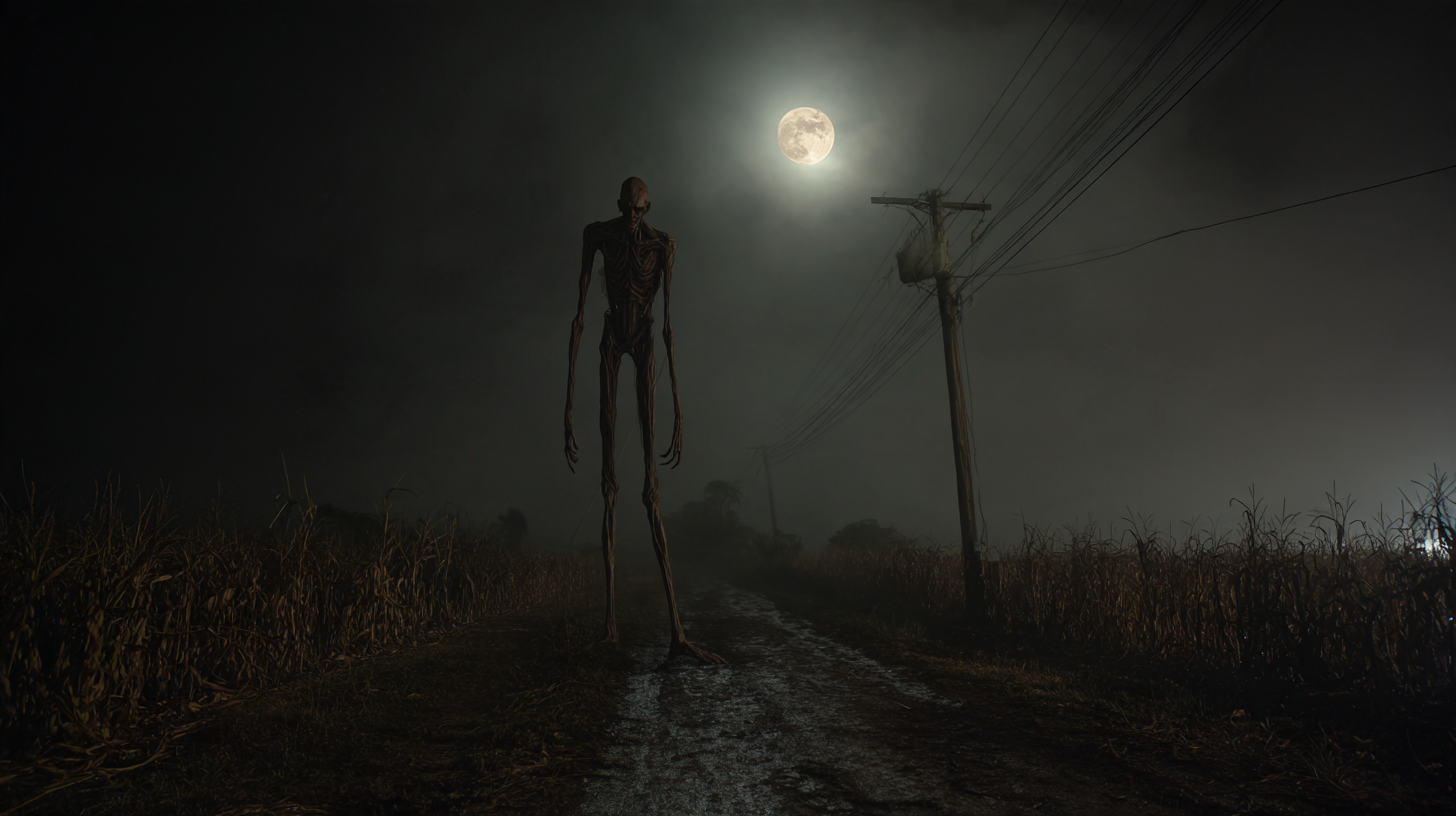
The moongazer is an extremely tall spectre. It stands at a crossroads on nights of the full moon, with its legs wide apart, straddling the road. Tellers in Trinidad, Guyana and St. Lucia know the story. Trinidad and St. Lucia also call it the Phantome.
Anyone who tries to walk under the figure and breaks its gaze is crushed when it snaps its legs shut. The only warning is a shrill whistle just before the attack. The moongazer can turn invisible, so only its shadow in the moonlight gives it away.
Some versions offer a way out. A traveller who walks around quietly is left alone. One who taunts it or distracts it from the moon is said to have the brain consumed through the palm of its hand.
The Baccoo of Guyana
The baccoo is a small, partly human spirit from Guyanese and Surinamese folklore. Its owner keeps it in a corked bottle and commands it to bring wealth or to harm others. Descriptions vary. Many tellers picture a short figure with a large head, big eyes, thin limbs and no kneecaps. Some say half of its body is wood.
The baccoo must be fed milk and bananas. If its owner neglects it, the spirit may turn on him. Some stories show a baccoo acting alone, throwing stones or starting fires. Folklorists link it to the Yoruba abiku, a child spirit, and to Akan traditions of small forest beings.
A related legend about a child-sized spirit, the Ti Bolom, is told in St. Lucia and nearby islands.
The Bush Dai-Dai
The bush dai-dai is a Guyanese spirit with Amerindian and Afro-Guyanese roots. Tales place her in the camps of gold miners in Guyana’s interior. She usually takes the form of a beautiful woman who visits the camps at night, and tales warn miners about her.
Tellers disagree on her form. Another description paints the Dai-Dai as a short forest spirit that guards gold. Both versions tie her to the rainforest and its wealth.
The Churile
The churile, also spelled choorile, is one of the best-known jumbies in Guyana and Trinidad. Tellers describe her as the spirit of a woman who died in childbirth while her baby lived. She is an angry, restless spirit who haunts the living.
The word has entered everyday speech. Older Guyanese sometimes apply it to a person who cries constantly or runs about in distress. The name resembles churel, a female ghost in South Asian folklore.
The Massacooraman and the Dutchman Jumbies
Guyana’s interior has its own jumbies. Amerindians and miners speak of the massacooraman, a powerful river spirit that pulls boats under the water.
Another group of jumbies recalls colonial history. The Dutchman jumbies are said to be the spirits of Dutch colonizers who committed killings. In death, tellers say, they returned to haunt the land.
Jumbie Protections Compared
Different jumbies call for different defences. Rice or sand at the door keeps a counting jumbie busy until dawn. Avoiding a child’s name after dark foils the douen. Walking around the moongazer quietly keeps a traveller safe.
For a baccoo, one field guide for young readers advises keeping a corked bottle handy. The idea is to trap the spirit inside, cork the bottle and throw it into the sea.
Jumbies in Modern Books
Jumbie stories keep reaching new readers. Author Tracey Baptiste wrote a children’s fantasy series called The Jumbies. She also published a playful field guide on how to recognize, trick and outmaneuver the creatures.
Common Questions About Jumbies
How do you spell and say jumbie?
People spell it jumbie, jumbee, jumbi or jumby. Say it JUHM-bee.
Is a jumbie the same as a duppy?
The words overlap. In many islands of the Lesser Antilles, people call duppies jumbies. Mendo is a third word for the same kind of spirit. Jamaica favours duppy, while Trinidad and Guyana favour jumbie. Read our guide to the duppy for the Jamaican side of the story.
Where are jumbies found?
Tellers in Trinidad, Guyana, Antigua and other islands know jumbies.
How does someone become a jumbie?
Some believe that a very wicked person becomes a jumbie three days after death. Others see jumbies as demons rather than ghosts.
Why Jumbies Differ From Island to Island
Guyana uses jumbie as a Creolese name for a host of spirits and demons. The Lesser Antilles often use it for the dead. Each place gives the word its own history.
Guyana’s jumbies show every layer of the region’s past. The massacooraman and the bush dai-dai carry Amerindian roots. The baccoo links to African child-spirit traditions. The Dutchman jumbies recall the colonial era.
That layering explains why one word covers so many beings. Each community added its own fears and its own remedies.
Jumbies at a Glance
- Meaning: a spirit in Caribbean folklore, spelled jumbie, jumbee, jumbi or jumby
- Found in: Trinidad, Guyana, Antigua and other islands
- Examples: the douen, the moongazer, the baccoo, the bush dai-dai, the churile and the massacooraman
- Common defence: rice or sand at the door, which a jumbie must stop to count
- Close relative: the Jamaican duppy
Related Articles
Caribbean Folklore: A Field Guide to Monsters and Haunted Places
The Ti-Bolom: Saint Lucia’s Little Man Who Works for the Devil
Haunted Places in Trinidad: Fort George, Chacachacare and Beyond


2 Comments
La Ciguapa: The Dominican Legend Explained
November 5, 2026[…] motif appears elsewhere in the Caribbean. Trinidad’s douen also has backward feet, as our jumbie guide […]
Haunted Places in Trinidad: Fort George and More
November 5, 2026[…] about spirits such as the jumbie helps explain many of these stories. Elsewhere in the region, Jamaica’s Port Royal offers […]