
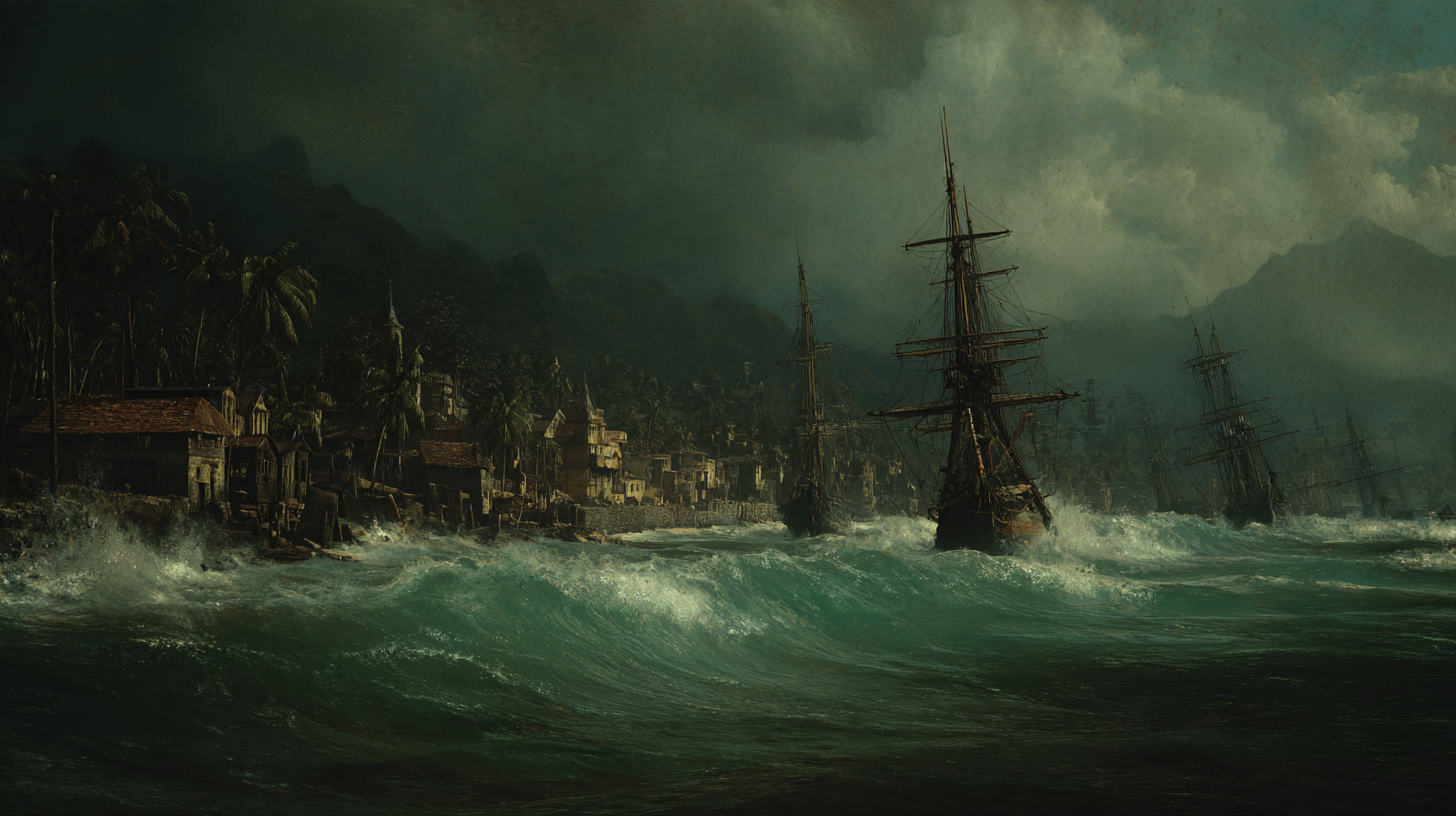
The Port Royal earthquake struck Jamaica on June 7, 1692, and sent about two thirds of a busy pirate port into the sea. It ranks among the worst natural disasters in Caribbean history. It also left behind a haunting legacy of ghost stories.
This guide explains what happened that morning, how Port Royal earned its reputation and why the ruins still draw tales of the dead. It forms part of our guide to Caribbean folklore.
What Happened in the Port Royal Earthquake?
The earthquake hit just before noon on June 7, 1692. A pocket watch recovered from the ruins stopped at about 11:40 a.m.
Port Royal sat on a spit of sand at the mouth of Kingston Harbour. About 6,500 people lived there. The shaking turned the loose, wet sand into liquid, a process called liquefaction. Roughly two thirds of the town slid into the harbour within minutes. A tsunami followed.
Estimates put the immediate death toll near 2,000. Aftershocks and disease killed many more in the following weeks and years. The colony moved its centre of power to Spanish Town. Kingston grew across the harbour as survivors resettled.
Why Port Royal Was Called the Wickedest City
Before the quake, Port Royal ranked among the busiest and richest ports in the Americas. It served as a home base for privateers and pirates. One record from 1662 counts about one tavern for every ten residents.
The label wickedest city on Earth mostly arrived after the disaster. Many writers saw the earthquake as divine punishment for the town’s sins. Historians point to geology instead. Port Royal sat on unstable sand.
Fires in the early 1700s and later storms finished the job. By the late 1700s, the town was largely abandoned.
Ghost Stories of Port Royal Today
Port Royal survives as a small fishing community with a few restored buildings. Much of the old city lies underwater. Underwater archaeologists have recovered everyday objects from the sunken streets, including that pocket watch.
That setting breeds ghost stories. Tales describe the drowned of 1692 lingering near the harbour. These stories rest on tradition rather than documents. Jamaicans have long called restless spirits duppies.
Jamaica’s later history produced outlaw legends such as Three Finger Jack.
Henry Morgan and the Buccaneer Years
England captured Jamaica from Spain in 1655, and Port Royal soon grew rich. Britain encouraged privateers to attack enemy ships. Many of them gathered at Port Royal to sell their plunder under the cover of legitimate trade. The town became a notorious hub of piracy.
Henry Morgan, the best-known privateer of the age, is tied to Port Royal. Visitor guides describe the town as the pirate’s base before the sea swallowed it. Fort Charles, built in the 1650s, sat at the heart of that world.
The Archaeology Beneath the Harbour
Archaeologists carried out underwater excavations at Port Royal in the 1980s and 1990s. They found everyday objects that show how people lived before the quake. The underwater sections of the town remain exceptionally well preserved under layers of sediment.
A French pocket watch from the ruins, stopped at the moment of the quake, became one of the most famous finds.
On July 12, 2025, UNESCO inscribed the Archaeological Ensemble of 17th Century Port Royal on the World Heritage List. It joined the Blue and John Crow Mountains as Jamaica’s second World Heritage site.
Fort Charles, Nelson’s Quarterdeck and the Giddy House
Fort Charles is the only fort in Port Royal that survived the 1692 earthquake. It began in the 1650s as Fort Cromwell and took its present name after Charles II returned to the English throne. A young Horatio Nelson commanded it at age 22. An inscription over a doorway marks the place where he lived.
The nearby Giddy House began life in 1888 as an artillery store. The 1907 earthquake tilted it by roughly 45 degrees and sank it halfway into the ground. Visitors who step inside report a dizzy, off-balance feeling. The building shows why the sandy ground at Port Royal proved so dangerous.
Planning a Visit to Port Royal
Port Royal sits at the tip of the Palisadoes peninsula, about 8 km from central Kingston. The drive takes around 30 minutes, depending on traffic. A focused visit to Fort Charles, its maritime museum and the Giddy House takes two to three hours.
Nearby Fort Rocky holds a small museum of artifacts. Check opening hours and entry fees before you go, since they can change.
Port Royal in Pop Culture
Port Royal looms over modern pirate fiction. The Pirates of the Caribbean films refer to the town heavily. Crews built their version of the city near Wallilabou on St. Vincent, and fans can still visit those film sets.
Common Questions About the Port Royal Earthquake
How many people died in the Port Royal earthquake?
Estimates range from about 2,000 to 3,000 deaths on the day. Many more died in the following weeks and years from injuries and disease.
How strong was the earthquake?
Modern estimates put the magnitude between about 7.5 and 7.7.
Is Port Royal still underwater?
Much of the old city lies beneath the harbour. A smaller community survives on the land at the tip of the peninsula.
Why did Port Royal sink?
Liquefaction caused most of the sinking. The shaking turned the wet sand beneath the town into liquid, and large sections slid into the harbour.
What Survived and What Did Not
The earthquake left Port Royal in ruins. Virtually every building became uninhabitable, and two forts fell. Fort Charles stood firm and remains the only fort in Port Royal to survive the disaster.
The survivors faced a second crisis. Disease spread through the cramped, damaged town and killed thousands more. Aftershocks discouraged rebuilding. The colony’s government moved to Spanish Town, and Kingston grew across the harbour.
Port Royal at a Glance
- Date: June 7, 1692, at about 11:40 a.m.
- Population: about 6,500 people
- Loss: about two thirds of the town sank into the harbour
- Cause: strong shaking, liquefaction and a tsunami
- Deaths: roughly 2,000 to 3,000 on the day, with many more afterward
- Status today: a UNESCO World Heritage Site since July 2025
Related Articles
Caribbean Folklore: A Field Guide to Monsters and Haunted Places
Three Finger Jack: The Outlaw Jamaica Still Talks About
Duppy: Jamaica’s Restless Spirits and the Legends Behind Them


2 Comments
Caribbean Folklore: A Field Guide to Monsters and Haunted Places - Your source for all things horror
November 5, 2026[…] Port Royal Earthquake of 1692: How a Pirate City Sank […]
Haunted Places in Trinidad: Fort George and More
November 16, 2026[…] such as the jumbie helps explain many of these stories. Elsewhere in the region, Jamaica’s Port Royal offers another haunted […]